Google AI Mode vs AI Overviews: Two Systems, Different Rules
AI Mode and AI Overviews cite different sources 86% of the time. Learn how each system works, what gets cited, and how to optimize for both in 2026
Google AI Mode vs AI Overviews: Two Systems, Different Rules
Most marketers treat Google's AI features as one thing. That's a mistake backed by data: Ahrefs analyzed 730,000 response pairs and found that AI Mode and AI Overviews cite the same URLs only 13.7% of the time. They reach similar conclusions about 86% of the time, but they get there through different sources, different formats, and different retrieval logic.
If your brand shows up in an AI Overview, that doesn't mean it'll appear in AI Mode. And if you're optimizing for only one of them, you're missing roughly two-thirds of the citations you could earn on Google alone. Here's how each system works, where they diverge, and what to do about it.
What Each System Actually Does
AI Overviews and AI Mode sit inside the same Google Search product, but they serve different purposes and behave differently under the hood.
AI Overviews: The Automatic Summary
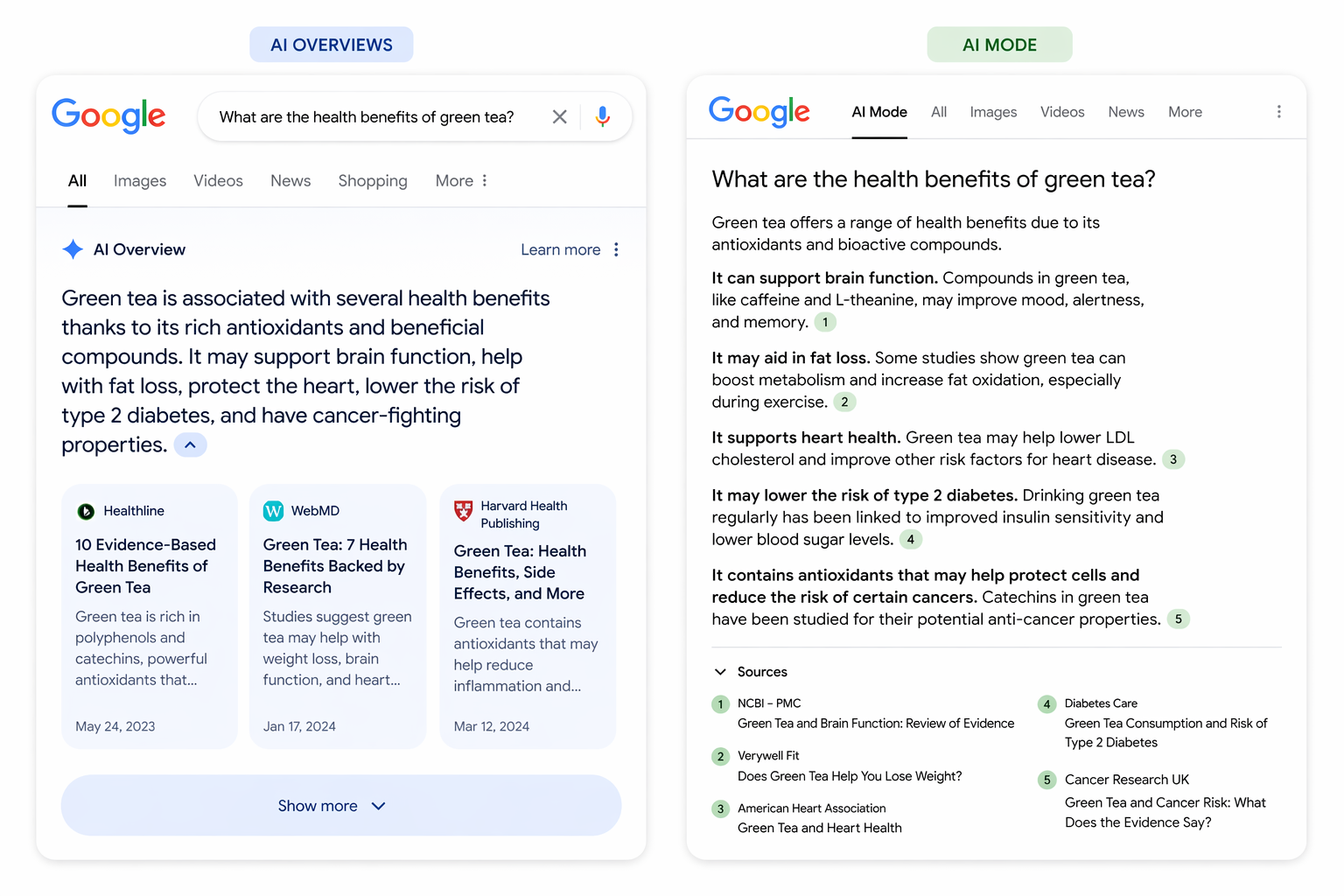
AI Overviews appear above traditional search results without the user asking for them. Google decides when a query benefits from an AI-generated summary and inserts one automatically. According to Conductor's 2026 benchmarks, roughly 25% of Google searches now trigger an AI Overview, though the rate varies by industry. Google reports that AI Overviews reach more than 2 billion monthly users across 200 countries.
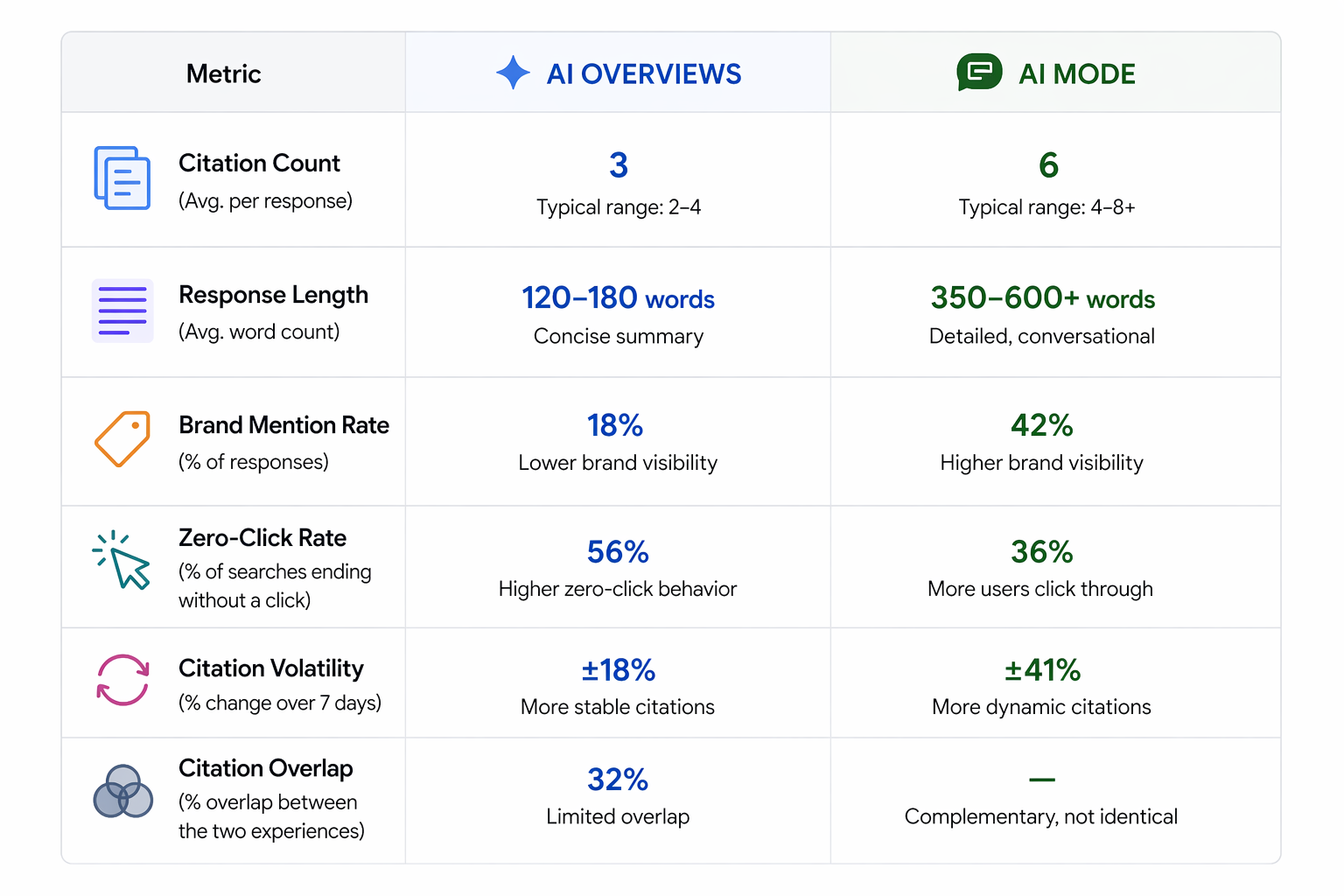
The format is compact. AI Overviews typically cite 2 to 5 sources, displayed as small citation cards alongside the summary. The responses tend to be short, focused on answering a single question quickly. Users still see the traditional blue links below.
AI Mode: The Conversational Research Tool
AI Mode is a separate, opt-in experience. Users choose to enter it when they want deeper, multi-step research. It's powered by Gemini 2.5 and reached over 100 million users in the US and India within months of its wider rollout. Unlike AI Overviews, AI Mode generates responses that are roughly four times longer on average and supports follow-up questions in a conversational thread.
AI Mode performs what Google calls "query fan-out": it breaks a single question into multiple parallel sub-searches, retrieves content across all of them, and synthesizes a comprehensive answer. It cites more sources per response and includes significantly more brand and entity mentions.
The Numbers That Change Everything
The Ahrefs study is the largest public analysis comparing these two systems. The findings reshape how brands should think about Google AI visibility.
Citation Overlap Is Minimal
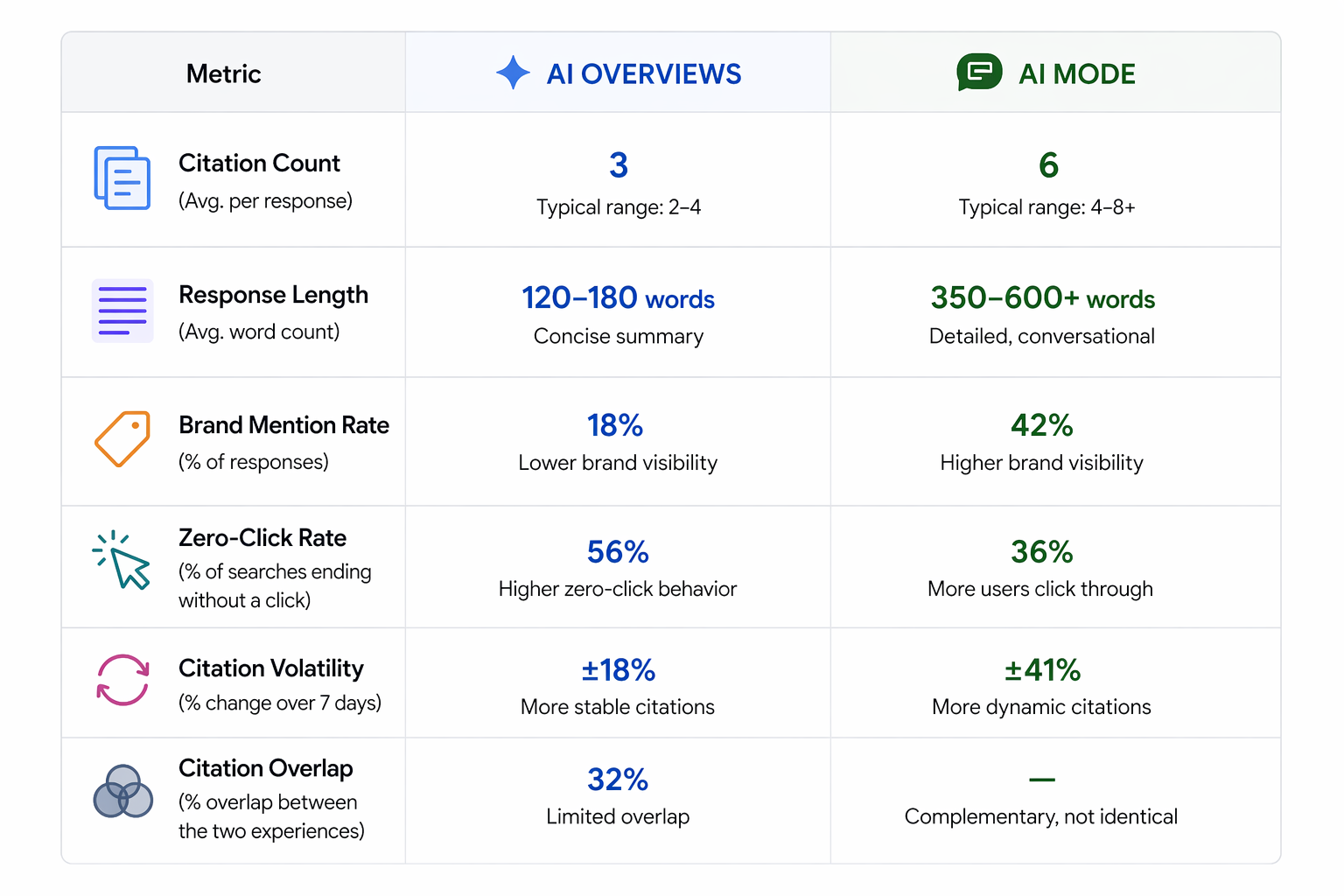
Only 13.7% of cited URLs overlap between AI Mode and AI Overviews for the same query. A separate Victorious study confirmed this range, finding 30 to 35% URL overlap, with 77% of unique domains appearing in only one of the two experiences. In practical terms, a brand cited in an AI Overview has no guarantee of appearing in AI Mode, and vice versa.
They Agree on What to Say, Not Where to Find It
Despite citing different sources, the two systems reach semantically similar conclusions 86% of the time. They share the same first sentence only 2.5% of the time, and word-level overlap sits at just 16%. Google's systems are independently researching the same questions and arriving at the same answers through different paths.
AI Mode Is Far More Brand-Friendly
SE Visible found that brands appear in approximately 90% of AI Mode responses, compared to just 43% in standard AI Overviews. AI Mode responses include 2.5 times more entity mentions on average (3.3 per response vs. 1.3 for AI Overviews). If your brand is mentioned in an AI Overview, there's a 61% chance it'll also appear in AI Mode's longer response. But the reverse doesn't hold: many brands visible in AI Mode are absent from AI Overviews entirely.
AI Overviews Citations Rotate Constantly
Semrush's AI Visibility Index reports that 40 to 60% of cited sources in AI Overviews change month over month. A page cited today may be replaced within weeks. AI Mode citations appear to be somewhat more stable, though both systems reward fresh content.
Different Source Preferences
The two systems don't just cite different URLs. They prefer different types of sources entirely.
AI Mode cites Wikipedia in 28.9% of responses vs. 18.1% for AI Overviews. It cites Quora 3.5 times more often and pulls from health-focused sites at roughly double the rate. AI Overviews lean more heavily on video content, with YouTube being one of its most frequently cited sources.
Both systems cite Reddit at similar rates. But Moz found that only 12% of AI Mode citations matched URLs from the top 10 organic search results for the same query. For AI Overviews, that overlap is somewhat higher but still inconsistent across studies, ranging from 22% to 75% depending on the industry and dataset.
One trend worth tracking: SE Ranking's February 2026 study found that Google.com itself accounted for 17.42% of all AI Mode citations, a figure that tripled from 5.7% in under nine months. Google is increasingly citing its own properties inside AI Mode.
Click Behavior: Two Very Different Funnels
The user behavior after seeing each format is starkly different. Around 93% of AI Mode searches end without a click to an external site, more than double the zero-click rate of AI Overviews. AI Overviews reduce clicks by roughly 58% compared to traditional results, which is significant but still leaves meaningful traffic.
However, the clicks that do come from AI Mode are higher quality. SimilarWeb's analysis of over 100,000 AI Mode users showed that visitors arriving from AI Mode spend more time on-site and view more pages per session compared to traditional Google results. They've already done the research inside AI Mode and click through only when they've decided to engage.
This reframes what "visibility" means. In AI Overviews, you're competing for citation-driven clicks. In AI Mode, you're competing for brand placement in a research conversation where the click may never happen, but the brand impression shapes future decisions.
Understanding how different AI engines cite brands differently adds another layer to this picture.
Commerce Is Splitting Too
Both systems now carry commercial features, but they work differently.
Google launched shopping ads with Direct Offers inside AI Mode in February 2026. Brands can show deals directly inside conversational AI responses. Google also introduced the Universal Commerce Protocol (UCP) in January 2026 for in-chat checkout, with Etsy and Wayfair going live and Shopify, Target, and Walmart coming next.
AI Overviews don't yet support the same level of transactional functionality. They show product carousels and knowledge panels but don't have built-in checkout. For e-commerce brands, this means AI Mode is quickly becoming a place where people buy, not just browse. Our breakdown of how ChatGPT ads affect brand visibility covers the parallel shift happening on OpenAI's side.
How to Optimize for Both Systems
The strategies overlap, but the emphasis differs. Here's a practical framework.
What Works for AI Overviews
AI Overviews pull more heavily from pages that already rank well in traditional search. Strong E-E-A-T signals, structured data, and content that directly answers common questions are the primary drivers. Think featured-snippet-style optimization: concise, authoritative, well-structured. Focus on FAQ schema, clear headings, and compact answer blocks.
Video content performs unusually well in AI Overviews. If you're producing YouTube content in your category, make sure it has proper transcripts, chapters, and structured metadata.
Update frequency matters. With 40 to 60% of citations rotating monthly, quarterly content refreshes aren't optional. Pages need visible "Last updated" dates and regular injections of new data.
What Works for AI Mode
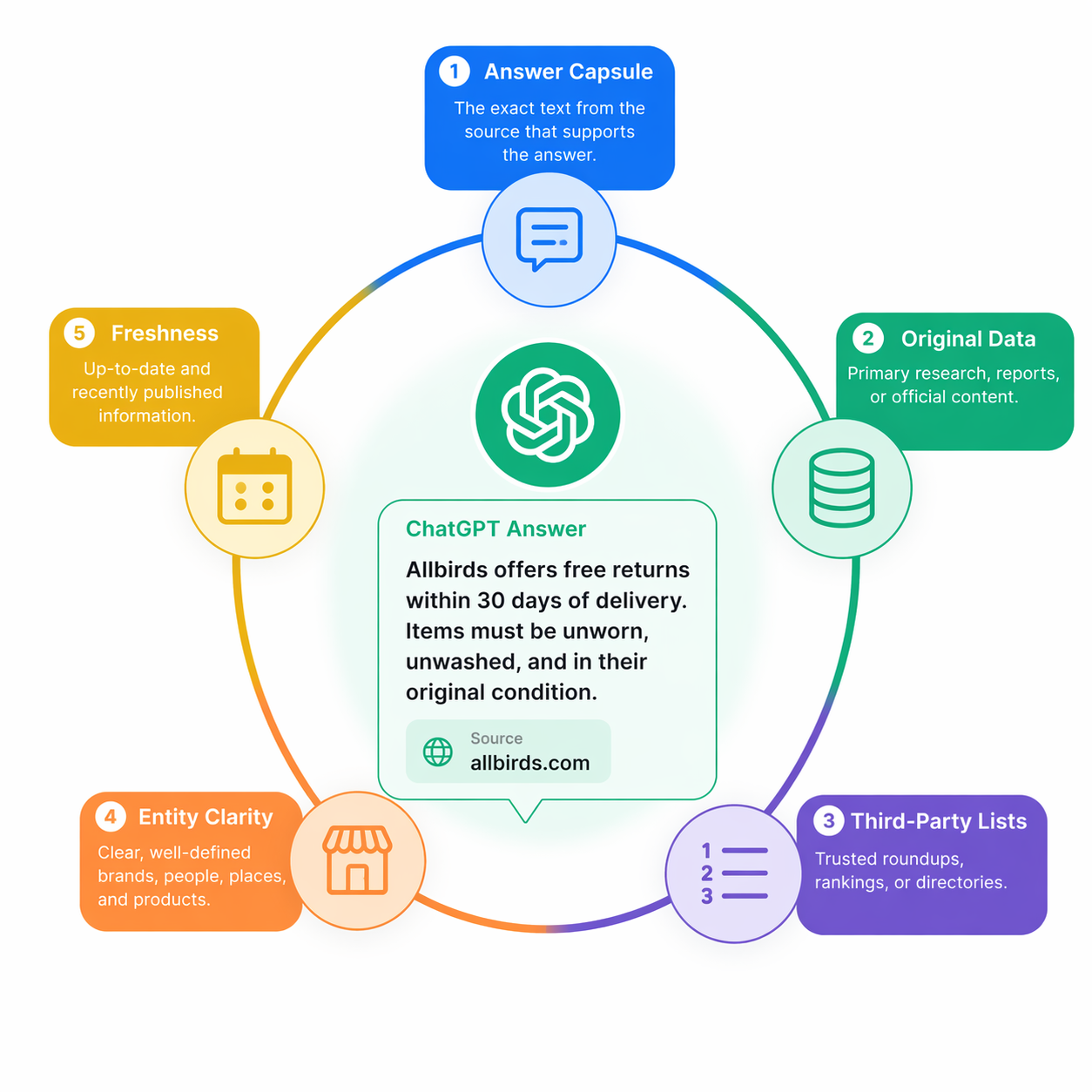
AI Mode rewards depth and topical coverage. Its fan-out query architecture means it's pulling from multiple pages across a topic cluster simultaneously. Single-keyword pages rarely get cited. Interconnected content hubs (a pillar page linking to supporting articles that each answer a sub-question) perform well because multiple pieces can get cited within a single AI Mode response.
Brand presence across third-party sources matters more here than in AI Overviews. AI Mode mentions brands in 90% of responses, and it builds that picture from review sites, Reddit threads, news coverage, and community mentions. Getting listed on G2, earning press coverage, and building a consistent off-site presence all feed directly into AI Mode citations.
Entity clarity is critical. AI Mode includes 2.5 times more entities than AI Overviews, which means it's actively looking for brand names, product names, and people to include. Comprehensive Organization schema markup with sameAs links gives Google the structured signals it needs to identify and cite your brand.
A Quick-Reference Comparison
AI Overviews priorities: concise answer blocks, FAQ schema, video content with transcripts, pages ranking in top 20, monthly content freshness, featured-snippet-style formatting.
AI Mode priorities: topical depth across content clusters, third-party brand mentions, entity-rich structured data, conversational content that answers multi-step queries, off-site presence on Reddit, G2, LinkedIn, and YouTube.
Both: clean crawler access, server-rendered content, mobile performance, original data, consistent brand messaging across the web.
Tracking Visibility Across Both Systems
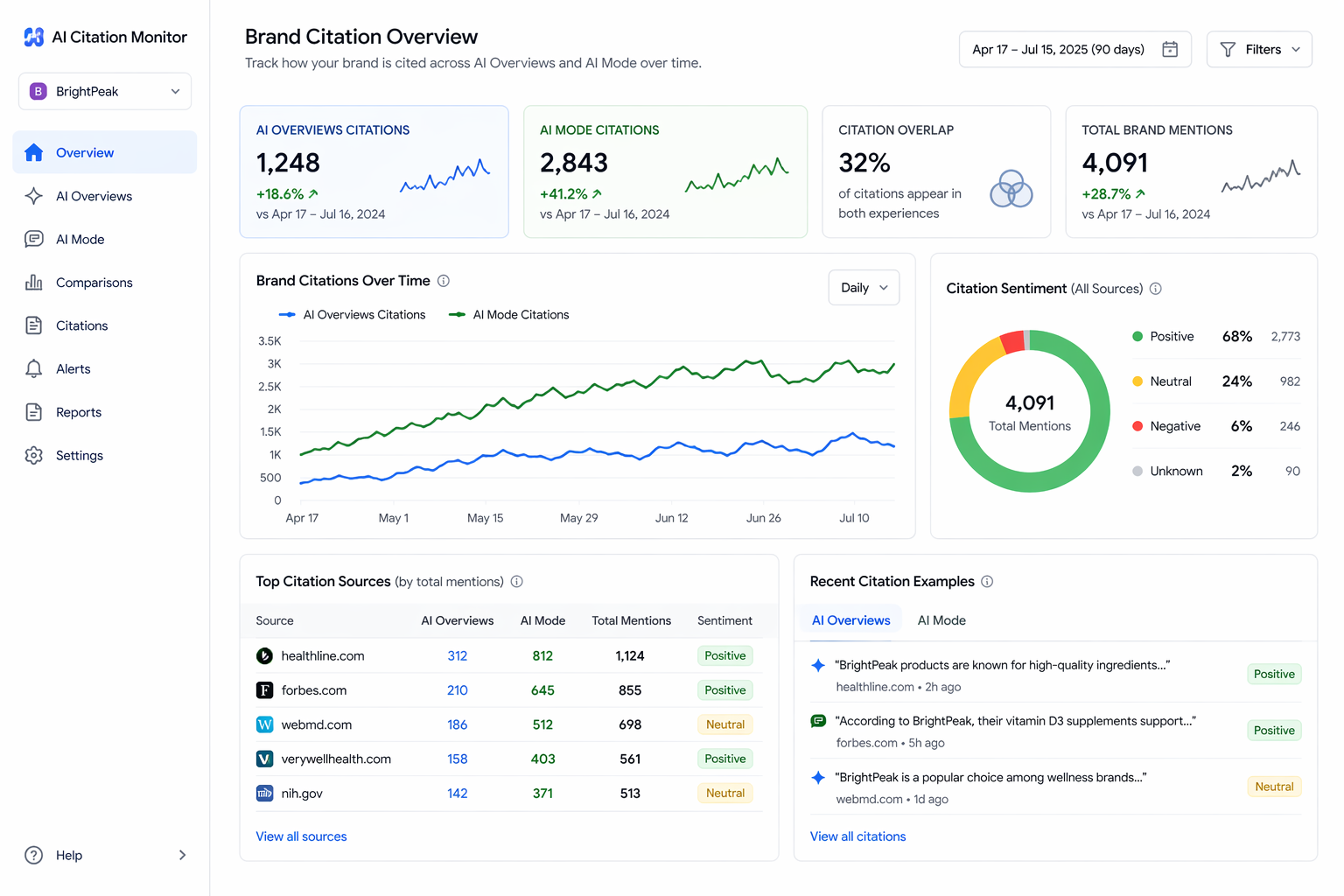
This is where most teams hit a wall. Google Search Console doesn't separate AI Mode traffic from traditional search. It doesn't tell you whether your brand was cited in an AI Overview or mentioned in an AI Mode response. And with AI Mode's 93% zero-click rate, most of your "visibility" won't even appear as traffic.
You need purpose-built monitoring. RepuAI tracks how your brand appears across AI surfaces, including both Google AI features, ChatGPT, Perplexity, and Claude. It monitors which prompts trigger your brand mentions, what sentiment those mentions carry, and how your citation presence shifts week over week. If a competitor displaces you in an AI Mode response for a key category query, you'll see it before it affects pipeline.
You can start with a free AI visibility check to see how your site currently looks to AI crawlers, and identify whether the gaps are on-page, structural, or off-site. From there, pairing a solid KPI framework with continuous monitoring turns citation data into something your team can actually act on.
What This Means for Your Strategy
The split between AI Overviews and AI Mode isn't a temporary glitch. It reflects Google's deliberate architecture: two systems that solve different user problems and pull from different source pools. Treating them as one system means under-optimizing for both.
The practical move is to run parallel tracks. Audit where your brand currently appears across both surfaces. Identify the queries where you're cited in one but not the other. Build content clusters that serve AI Mode's depth requirements while including concise answer blocks that AI Overviews can extract. And invest in the off-site presence (reviews, press, community mentions) that AI Mode weights so heavily.
Brands that figure this out in 2026 earn a compounding advantage. Both systems favor sources they've cited before, which means early citation wins build into persistent visibility. The ones still optimizing for "Google AI" as a single category will keep wondering why their coverage feels incomplete.