Google AI Overviews: What They Mean for Your Brand Visibility
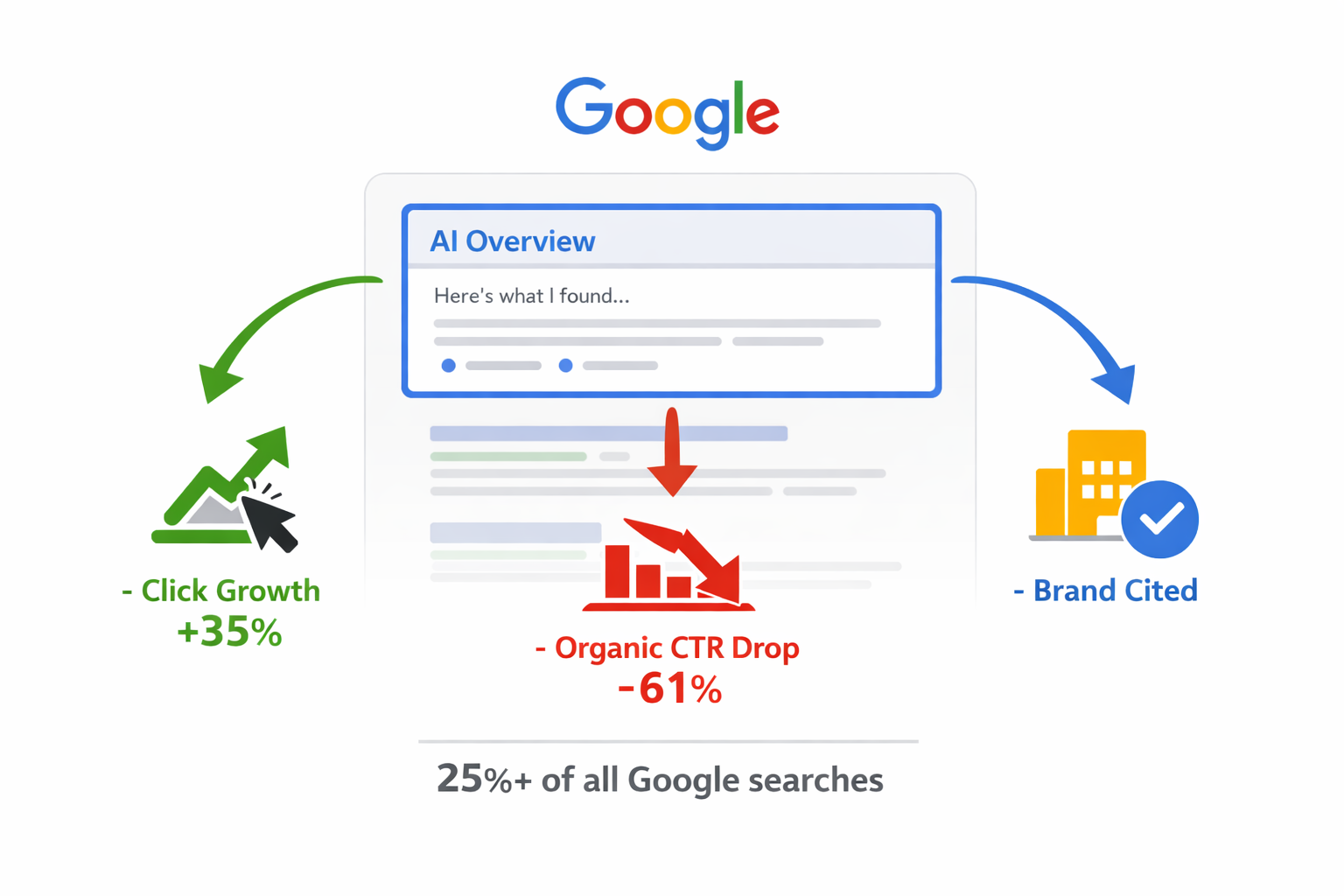
Google AI Overviews now appear on 25%+ of all searches. Learn how they affect brand visibility, what gets cited, and how to monitor your presence inside them

Google AI Overviews now appear on more than 25% of all searches, up from 13% a year ago. For queries starting with "best," that number jumps to 83%. When an AI Overview shows up, organic click-through rates drop by 61% on average. But brands that get cited inside those overviews earn 35% more organic clicks and 91% more paid clicks than brands that don't.
That's the split every marketing team needs to understand. AI Overviews aren't eliminating search traffic. They're redistributing it, and the brands getting cited are capturing a disproportionate share while everyone else loses ground. If you're not tracking whether your brand appears inside these summaries, you're missing the fastest-growing visibility channel in search.
What AI Overviews Actually Are (and Aren't)
Google AI Overviews are AI-generated summaries that appear at the top of search results, above both paid ads and organic listings. They synthesize information from multiple web pages into a single conversational answer, with source links collapsed in a panel below.
This is fundamentally different from featured snippets. Featured snippets pull content from one page. AI Overviews read multiple sources, weigh their credibility, and produce a new synthesis. Your brand can be cited even if you don't rank first, and you can be excluded even if you do.
There's also a distinction worth making between AI Overviews and Google's newer AI Mode. AI Overviews appear automatically within regular search results. AI Mode is a separate, opt-in conversational interface similar to ChatGPT. Both use structured data and authority signals to select sources, but they cite different content: only 13.7% of citations overlap between the two. A brand visible in AI Overviews isn't automatically visible in AI Mode, and vice versa.
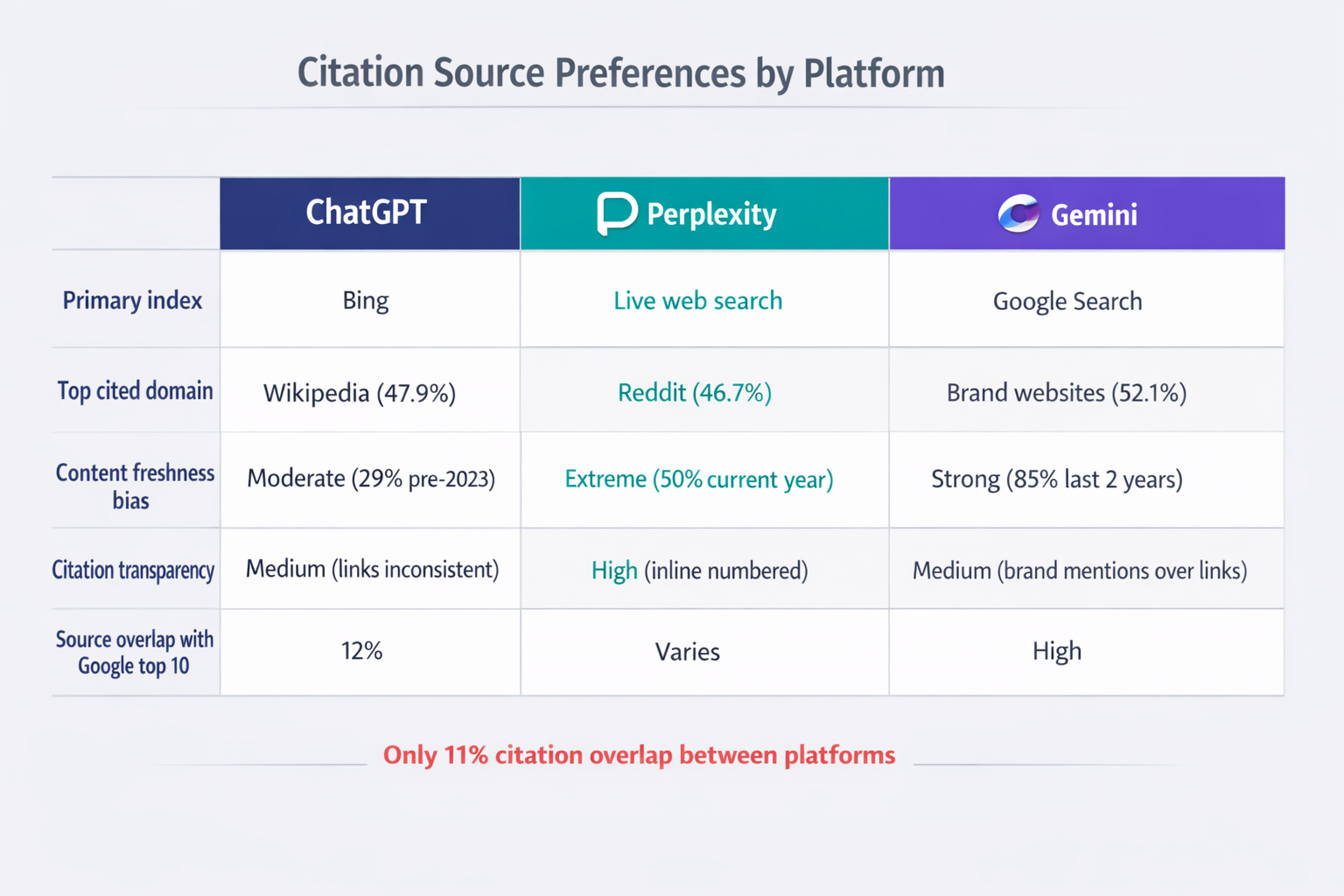
For marketers already familiar with how different AI platforms select sources (something RepuAI's comparison of Perplexity, ChatGPT, and Gemini covers in detail), AI Overviews represent yet another surface with its own citation logic.
The Numbers That Matter
The data from early 2026 paints a clear picture of AI Overviews' growing influence:
AI Overviews now reach roughly 2 billion monthly users globally. In the US, they trigger on approximately 50% of search queries, and for question-based queries, the rate climbs to nearly 58%. Specific verticals have seen explosive growth: entertainment queries saw a 528% increase in AI Overview appearances, restaurants 387%, and travel 381%.
On the traffic side, zero-click searches hit 58.5% across all Google searches. When AI Mode specifically is engaged, zero-click rates reach 93%. These aren't projections. They're current measurements.
But the story isn't purely about traffic loss. AI Overview traffic converts at 14.2% compared to traditional organic's 2.8%, a 5x quality premium. Fewer visitors, dramatically higher intent. The people who do click through from an AI Overview are further along in their decision process and more likely to buy.
The competitive implication is straightforward. If your brand is cited in AI Overviews, you're reaching the highest-intent searchers on Google's biggest platform. If you're not, your competitors are getting that implicit endorsement instead.
What Gets Cited (and What Gets Ignored)
The assumption that strong organic rankings guarantee AI Overview citations no longer holds. In early 2025, roughly 76% of AI Overview citations came from top-10 ranked pages. By early 2026, that figure dropped to approximately 38%. Google upgraded AI Overviews to Gemini 3 in January 2026, and the model now pulls from a much wider range of sources.
Pages ranking #6 through #10 with strong E-E-A-T signals are now cited 2.3 times more frequently than #1-ranked pages with weak authority signals. Ranking helps, but it's no longer enough on its own.
What AI Overviews actually look for when selecting sources:
Semantic completeness. Content that fully answers a query in a self-contained passage of 130 to 170 words gets selected far more often than content that requires reading the entire page. Each section under an H2 heading should open with a standalone answer that an AI could extract and quote directly.
Entity clarity. Pages with clear Organization and Article schema markup get higher trust scores. AI Overviews use schema to verify who published the content, when it was last updated, and whether the source is a recognized entity or an anonymous domain.
Third-party validation. An internal analysis found that 85% of brand mentions in AI responses originate from third-party pages, not from brands' own domains. Reddit threads, industry publications, review sites, and listicle articles that mention your brand contribute more to your AI Overview visibility than your own website content.
Content freshness. AI Overviews favor recently published or recently updated content. Citation performance typically begins declining within 4 to 5 days without content updates. The dateModified property in Article schema is a key signal here.
Multimodal content. Pages combining text, images, video, and structured data see significantly higher selection rates. This aligns with Google's broader push toward multimodal search.
The format matters too. Listicle-style content ("Top N" comparisons and rankings) accounts for nearly 60% of all cited URLs in AI search. Product pages make up only about 8.5%. If your content strategy focuses primarily on product pages and corporate messaging, you're structurally disadvantaged in AI Overview visibility.
AI Overviews vs. AI Mode vs. Gemini: Three Google Surfaces, Three Citation Logics
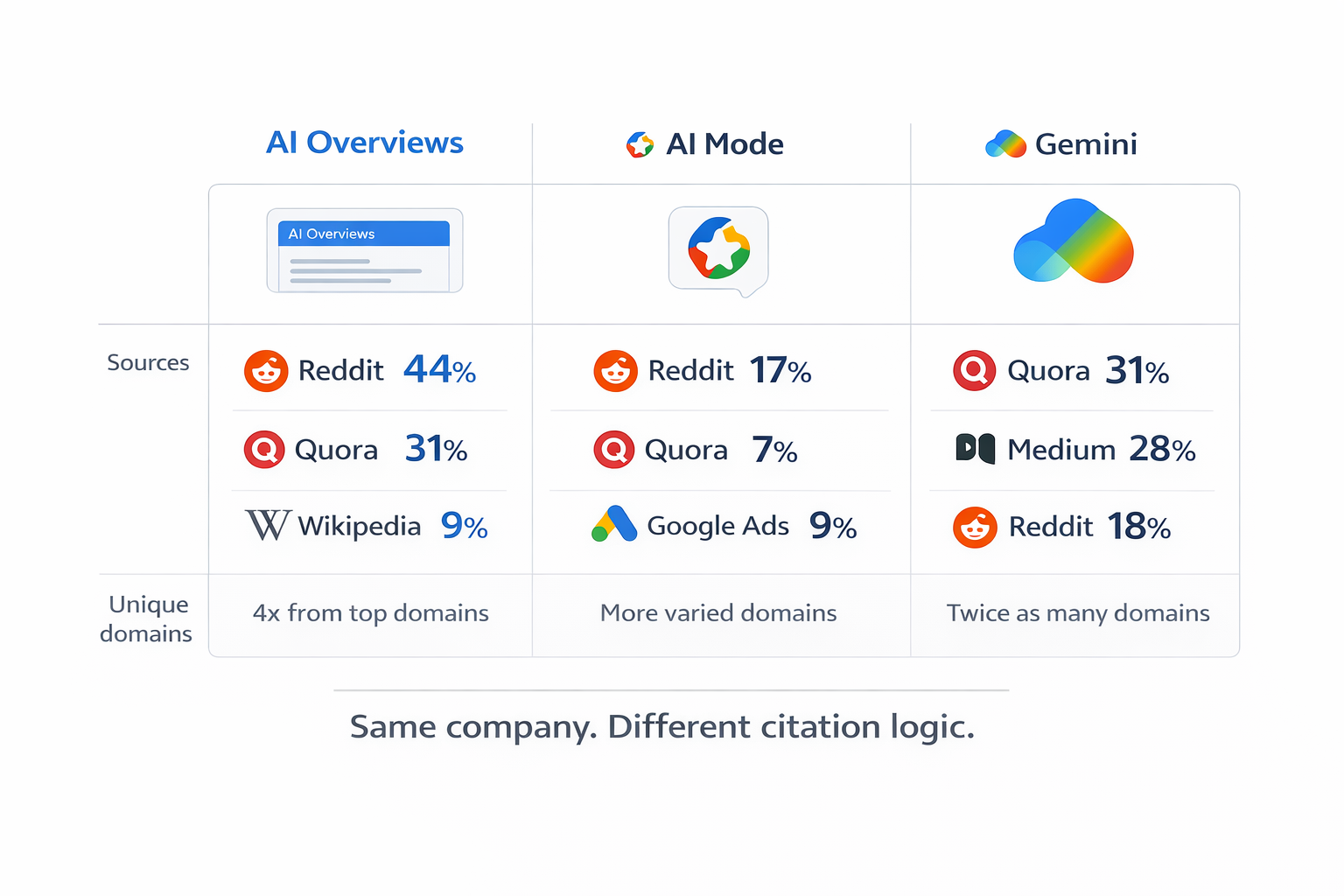
One of the most counterintuitive findings from 2026 is that Google's own AI products don't cite the same sources. Treating "Google AI" as a single channel is a mistake.
AI Overviews lean heavily on Reddit (44% of social citations in January 2026) and YouTube. They behave closest to traditional SERPs but with heavy community-content influence. They favor content that already ranks well organically, though the correlation is weakening.
AI Mode pulls from a much longer tail of domains, citing 143% more unique domains than AI Overviews. Its social citation mix is more balanced, with Reddit less dominant and a wider distribution across platforms.
Gemini operates on a strikingly different logic. Reddit accounts for only 5% of its social citations (compared to 44% for AI Overviews). Medium carries 28% of Gemini's social citations. YouTube registers 29%. If your audience primarily uses Gemini, investing in Reddit discussions may be less effective than expert editorial content on platforms like Medium.
The practical implication: a brand that builds its AI strategy around one Google surface will underperform on the others. Your content needs to work across all three, which means combining community presence (for AI Overviews), long-tail depth (for AI Mode), and editorial authority (for Gemini).
This is where the SEO, AEO, and GEO framework becomes useful. AI Overviews sit at the intersection of AEO (structuring content for direct answers within Google) and GEO (building the authority signals that earn citations). Strong GEO optimization improves your chances across all three Google surfaces simultaneously.
How to Check Your Current AI Overview Visibility
Before optimizing, you need to know where you stand. Most brands have no idea whether they're being cited in AI Overviews, let alone how often or how accurately.
Manual spot-check (start here). Pick 10 to 15 questions your ideal customer would type into Google, phrased as real queries: "best [your category] for [use case]," "how to choose [your product type]," "[your brand] vs [competitor]." Run each query in Google and check whether an AI Overview appears. If it does, expand the source panel. Is your brand cited? Is the information accurate? Which competitors show up?
Systematic monitoring. Manual checks don't scale. They miss query variations, geographic differences, and day-to-day fluctuations. AI Overview appearances are dynamic and inconsistent. A brand cited on Monday may not appear on Thursday for the same query. Tools like RepuAI track your brand's presence across Google AI, ChatGPT, Perplexity, Gemini, and Claude automatically, so you can see citation frequency, sentiment, and competitor comparisons over time. You can start with the free AI Visibility Checker for a quick baseline.
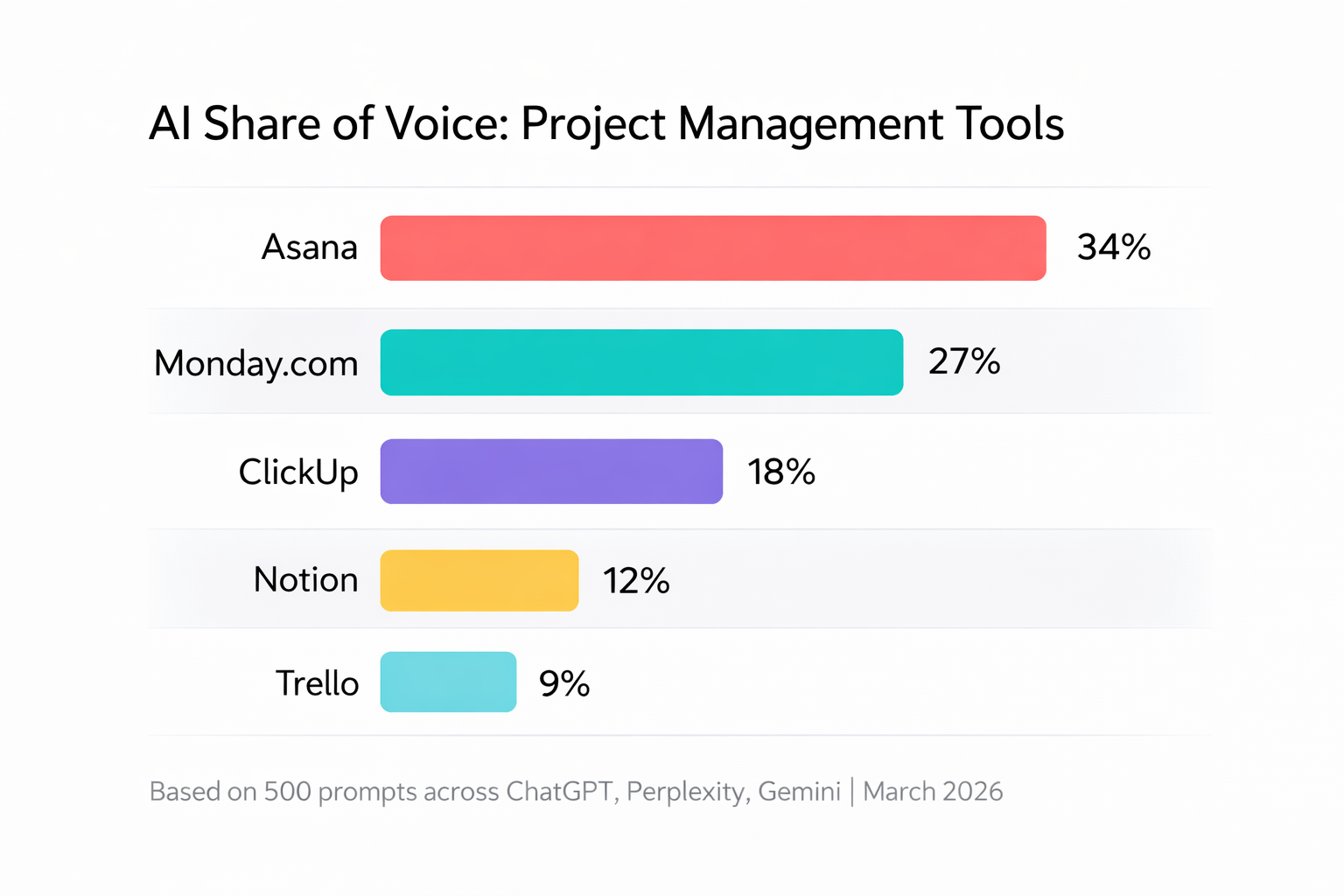
Track the right metrics. Traditional rank tracking doesn't capture AI Overview performance. The metrics that matter are: AI Overview presence rate (what percentage of your target queries trigger an overview that cites you), citation share of voice (how your citation frequency compares to top competitors), and brand mention frequency (how often your brand is named inside the generated text, separate from source citations).
A Practical Optimization Playbook
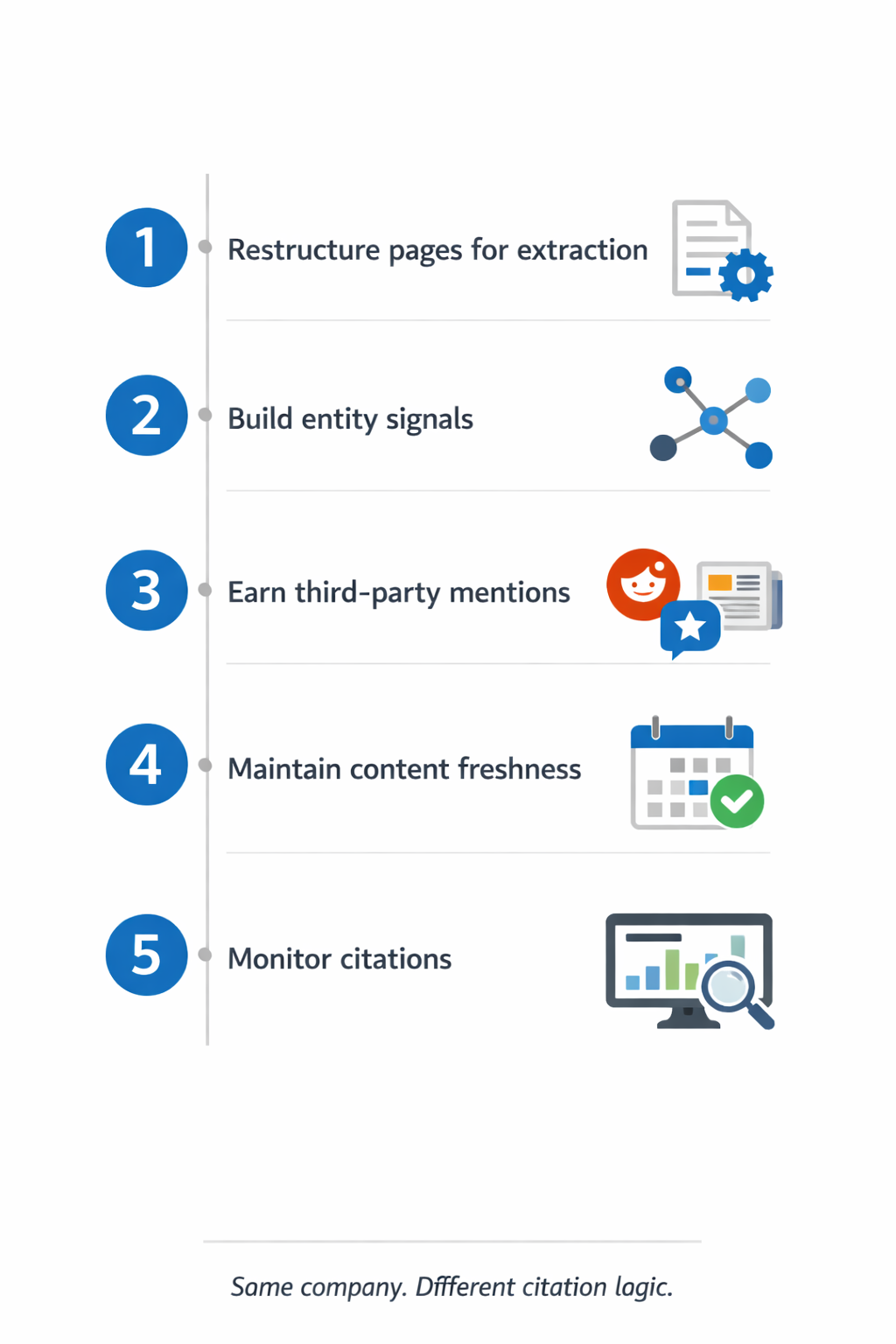
Based on the data from early 2026, here's what actually moves the needle for AI Overview visibility:
Restructure your key pages for extraction. The first 60 words after each H2 heading should be a complete, standalone answer. Write it as if it might be quoted directly in an AI-generated summary. Follow with supporting evidence: statistics, research citations, and expert quotes that give the AI confidence in your claims. This aligns with the content formats that AI engines prefer to cite.
Build your entity signals. Implement Organization schema site-wide with sameAs links to your Wikipedia page, LinkedIn, and social profiles. Add Article schema with accurate dateModified on every content page. Use knowsAbout to declare your topical expertise. These signals help Google's AI confirm your brand as a verified entity worth citing.
Invest in third-party presence. Since 85% of AI brand mentions come from third-party pages, your own website is necessary but not sufficient. Get your brand mentioned in industry listicles, comparison articles, and review roundups. Participate authentically in relevant Reddit and community discussions. Earn press mentions in reputable publications. These external signals are what AI Overviews use to validate whether your brand deserves a recommendation.
Maintain content freshness. Update your key pages at minimum quarterly. Change the visible content (not just the dateModified tag) with new data, examples, or insights. AI Overviews favor fresh, substantive updates. Cosmetic changes add noise. Google can tell the difference.
Create answer-focused content at scale. Listicle and comparison content gets cited far more than product pages. Publish comprehensive guides, "best of" roundups, and comparison articles in your category. These formats match what AI Overviews are designed to extract and synthesize.
What AI Overviews Mean for Your Existing SEO
AI Overviews don't replace traditional SEO. They add a layer on top of it. The fundamentals (crawlability, site speed, clean architecture, quality backlinks) still determine whether your pages are eligible to be considered. But eligibility and selection are two different things.
Think of it as a two-track system. For transactional queries ("buy [product]," "[brand] pricing"), traditional organic results still dominate. AI Overviews rarely appear for these, and when they do, they're less influential. Your SEO playbook for these queries doesn't need to change.
For informational and commercial research queries ("best [category] for [use case]," "how to choose [product type]," "[brand A] vs [brand B]"), AI Overviews are now the primary visibility surface. These queries are where your brand either gets cited with an implicit Google endorsement or gets bypassed entirely. Your optimization strategy for these queries needs to incorporate the extraction-focused, entity-driven, freshness-conscious approach outlined above.
The brands winning in this new landscape aren't abandoning SEO. They're layering AI Overview optimization on top of a solid SEO foundation, exactly the way the SEO, AEO, and GEO model describes. SEO makes you eligible. AEO formatting makes you extractable. GEO authority signals make you the source the AI chooses to cite.
The Window Is Still Open
Only 274,455 domains have ever appeared in AI Overviews out of the 18.4 million in Google's index. The competitive field is still small. The brands establishing citation authority now will have compounding advantages as AI Overviews expand to more queries and more markets.
Once an AI system selects a trusted source, it tends to reinforce that choice across related queries. Early movers don't just win today's citations. They make it harder for late entrants to break in.
Start by checking where you stand. Run your core queries, see whether you show up, and identify the gaps. Then work systematically: restructure your top pages for extraction, strengthen your entity signals, and build the third-party presence that AI Overviews rely on when deciding which brands to trust.
The shift from "ranking on Google" to "being cited by Google's AI" is already well underway. The question isn't whether it matters. It's whether your brand is in the answer.