What Type of Content Gets Cited by AI Search Engines?
Discover what types of content get cited by AI search engines like ChatGPT, Perplexity, and Gemini. Data-backed guide with actionable formats, structures, and examples
When a potential customer asks ChatGPT to recommend the best tool in your category, the model doesn't show ten blue links. It names two or three brands, explains why they stand out, and moves on. If your content isn't part of that answer, your brand doesn't exist in that moment.
The question most marketers still get wrong isn't whether AI search matters. It's what kind of content actually earns a place inside those answers. Not all pages are created equal in the eyes of an LLM. Research across hundreds of thousands of AI-generated citations now gives us a much clearer picture of what gets picked and what gets skipped.
AI Doesn't Rank Pages. It Picks Sources.
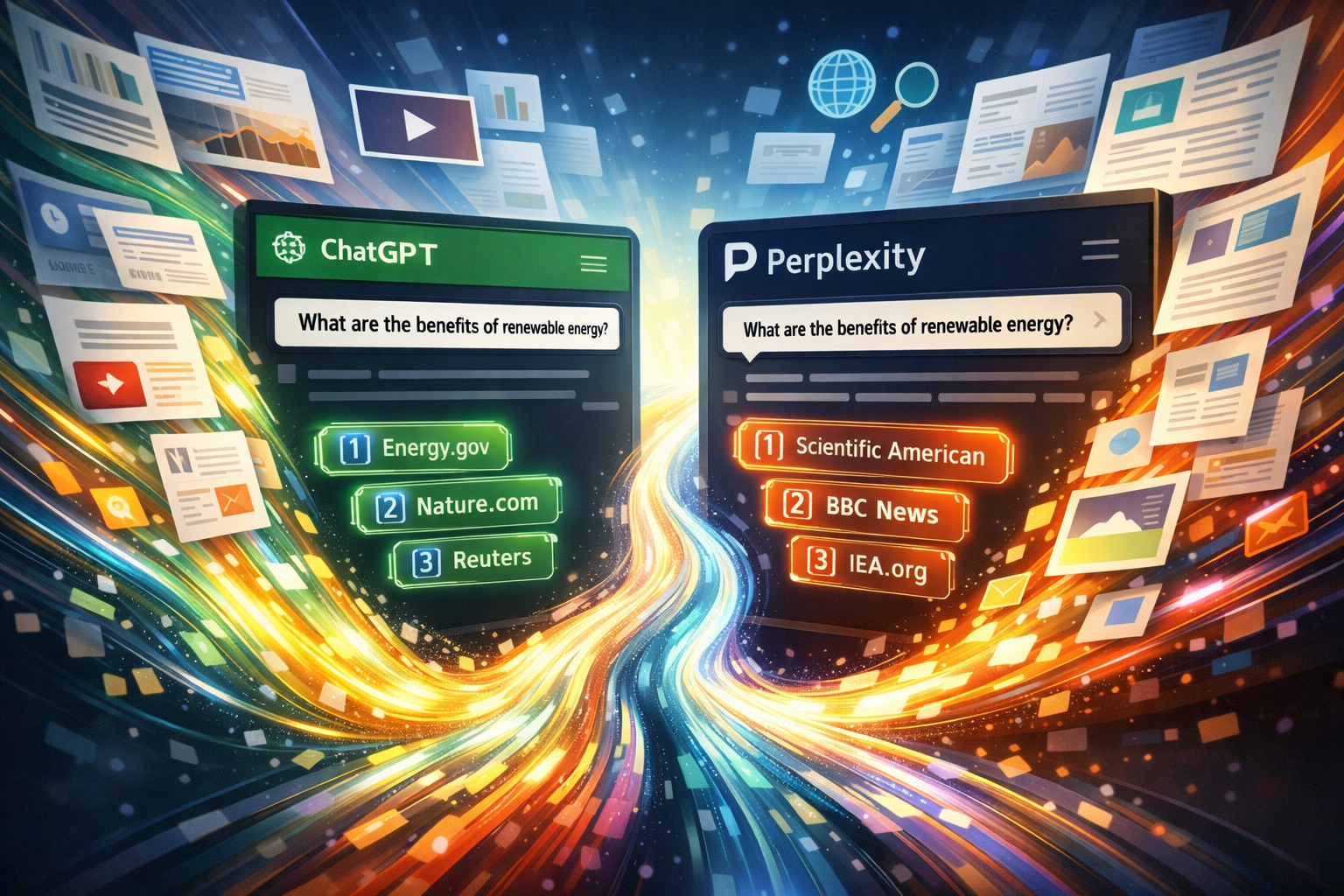
Traditional search engines rank pages. AI search engines pick sources to synthesize into a single answer. That distinction changes everything about how content needs to be built.
An analysis of nearly 8,000 citations across four major AI engines found that blog-style articles accounted for roughly 46% of all cited content, while mainstream news made up about 20%. Community content from platforms like Reddit and Quora contributed around 4%, and LinkedIn articles also appeared consistently. But format alone doesn't explain why one article gets cited while another on the same topic gets ignored.
AI models evaluate content through a lens that combines structural clarity, factual precision, and source authority. A page can rank number one in Google and still be invisible to ChatGPT if it's buried in vague prose without clear answers. One study found only 12% of ChatGPT citations matched URLs that appeared on Google's first page. Strong organic rankings help, but they don't guarantee AI visibility.
The Formats That Win Citations
Not every content type performs equally well across AI search engines. Here's what the data shows about which formats consistently earn citations.
Q&A and FAQ Content
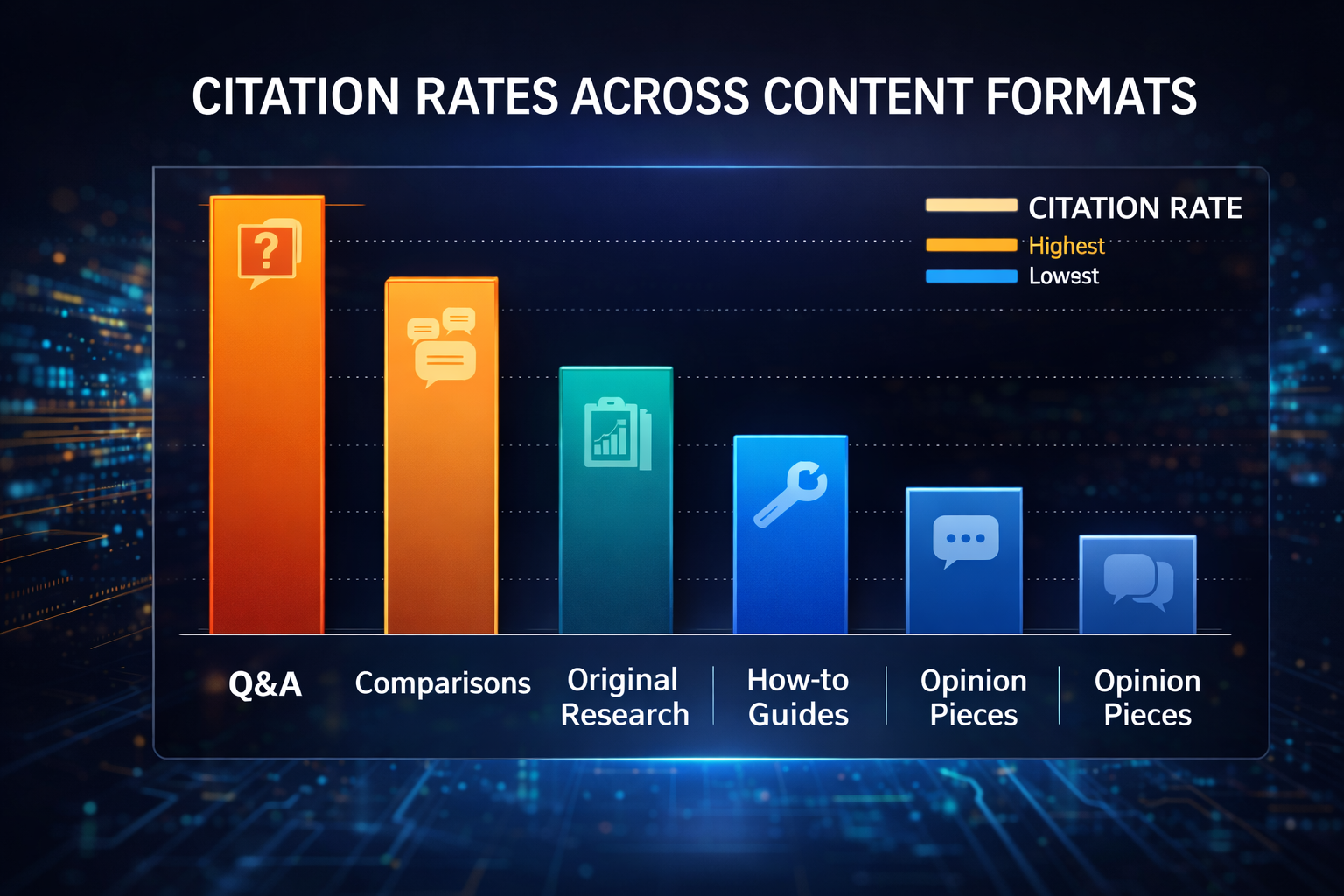
Q&A is the single best-performing format for AI search. When a user's query matches a question your page already answers in clear, structured language, the AI can extract and attribute that answer with minimal friction. Research from Spotlight found that 35% of cited corporate content included FAQ sections. Pages with FAQ schema markup see measurably higher citation rates because they help AI systems identify the question-answer relationship without guessing.
Comparison and "Best Of" Lists
When AI models respond to queries like "best CRM for small teams" or "Notion vs Asana," they're looking for structured comparisons. A study of GPT-4 training patterns found that comparison tables and short lists were cited more frequently than long thought-leadership essays. The reason is simple: these formats mirror the shape of the answer the AI is trying to construct.
Original Data and Research
Pages that include original data tables earn significantly more AI citations than those relying on secondhand information. Princeton's GEO research showed that adding specific statistics boosts citation performance by more than 5.5% compared to using single optimization tactics alone. First-party surveys, benchmark studies, and anonymized case data give AI engines something they can't find anywhere else, which makes your page the only viable source for that claim.
Step-by-Step Guides and How-To Content
Structured how-to content with numbered steps and clear headings performs well because it maps directly to how AI constructs instructional answers. The key is leading each section with the answer before expanding into detail. Content that opens with a direct answer in the first 100 words performs measurably better in AI citation selection.
Structure Matters More Than Length
AI systems parse content by breaking it into segments and analyzing how ideas connect. Pages using clear H2 and H3 structures with descriptive headings are significantly more likely to be cited. Dense, unstructured prose performs worst across all AI engines.
Here's the structural pattern that cited content follows:
Descriptive headings that state what the section covers. Don't use clever or vague headlines. A heading like "How Schema Markup Improves AI Citations" tells the model exactly what the section delivers. A heading like "The Missing Piece" tells it nothing.
Front-loaded answers. Research shows that 44.2% of all LLM citations come from the first 30% of a page's text. If your key point is buried in paragraph seven, most AI models won't reach it. Lead with the answer, then support it with evidence.
Short paragraphs with one idea each. AI extracts information in chunks. When a paragraph mixes three different claims, the model either picks one or skips the whole block. Keep each paragraph focused on a single point.
Tables for comparative data. Structured tables help AI systems process and reproduce information with minimal ambiguity. When you're comparing features, pricing, or approaches, a table outperforms prose every time.
What Each AI Engine Prefers
Different AI search engines source content differently. A strategy that works for Perplexity may underperform on ChatGPT, and vice versa.
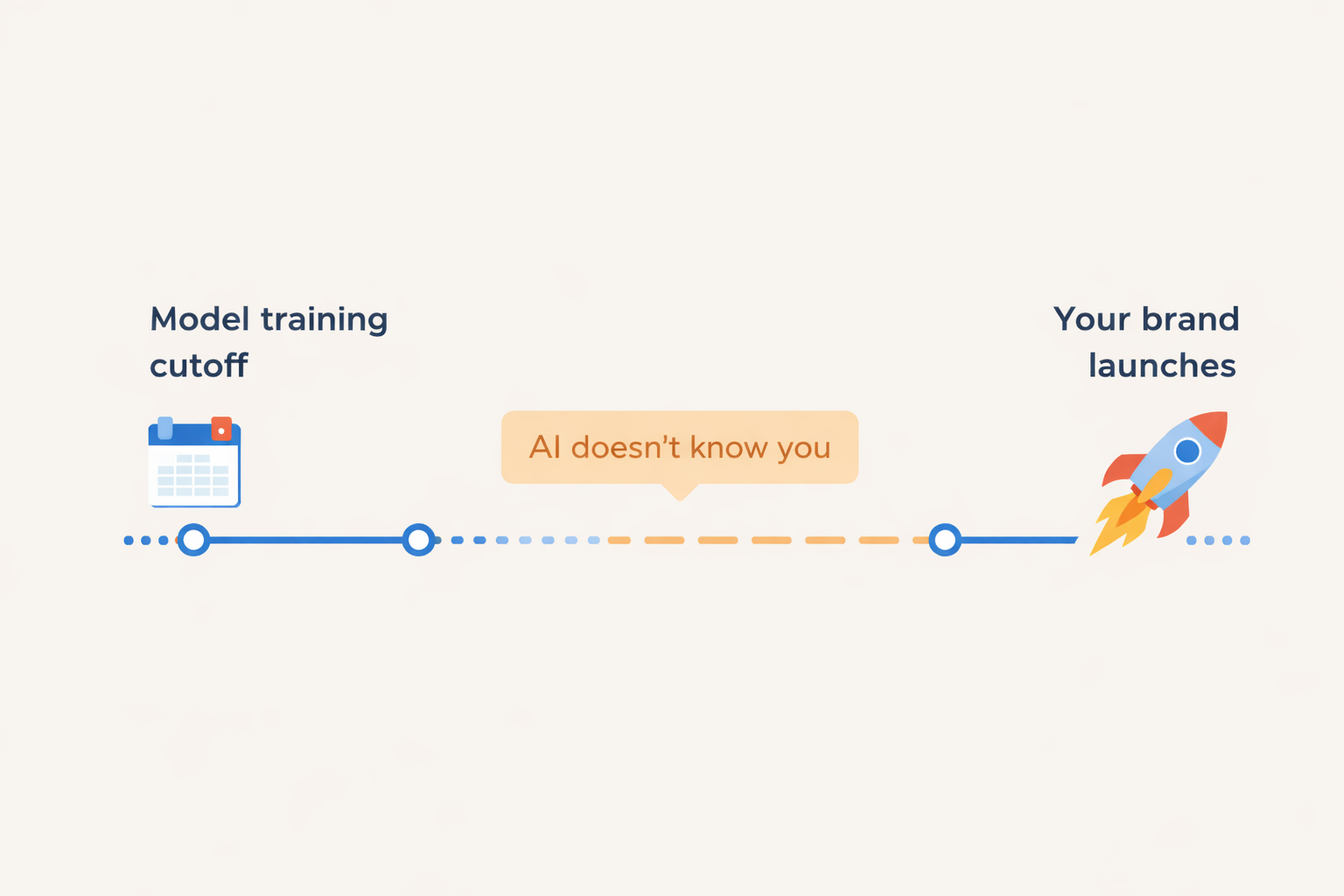
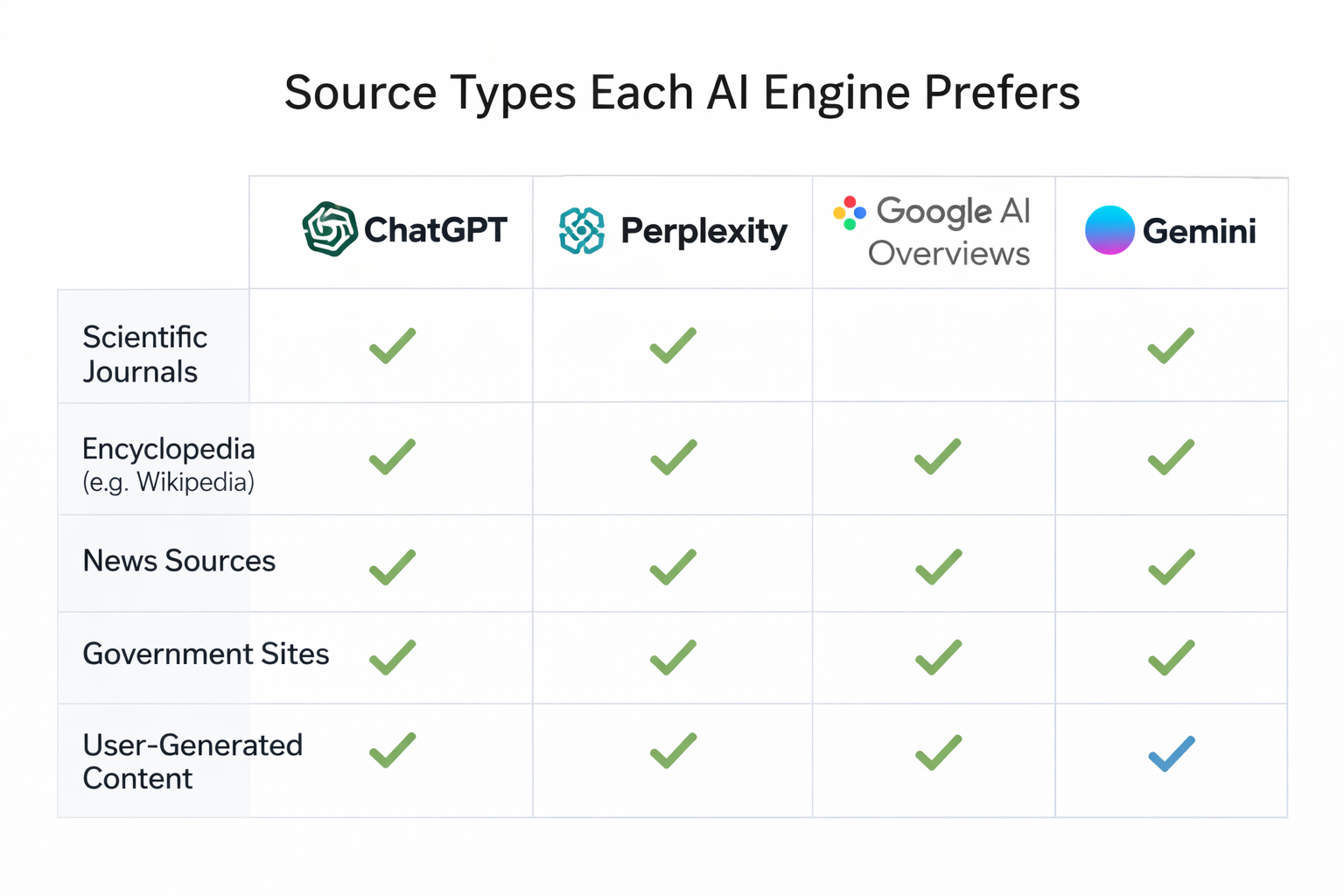
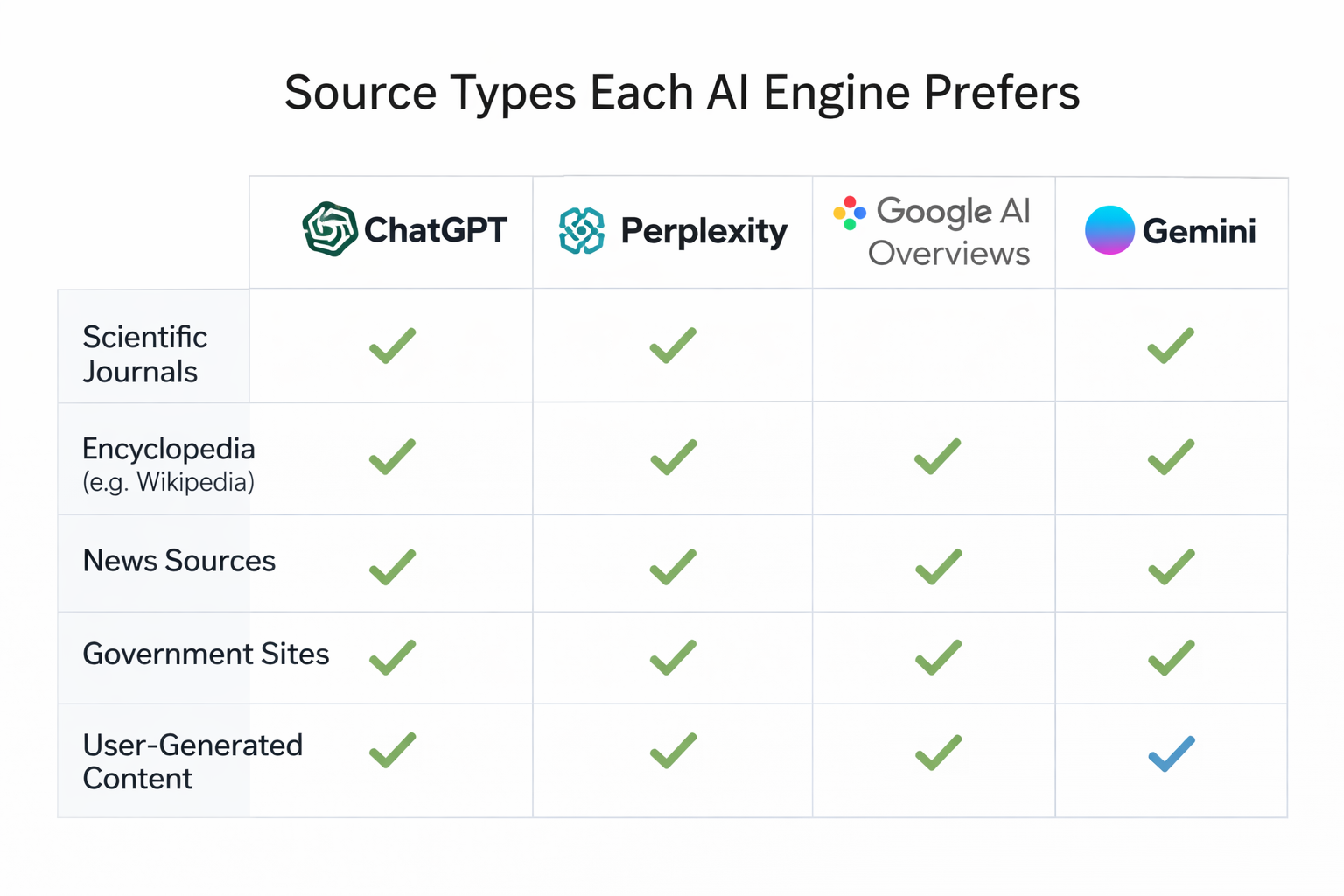
ChatGPT relies on a mix of its training data and, when browsing is enabled, Bing's search index. Wikipedia is its most-cited single source. It tends to favor encyclopedic, factual content and leans heavily on platforms like LinkedIn, G2, and Gartner for product-related queries. ChatGPT also references older content more frequently than other engines, with 29% of its citations dating back to 2022 or earlier.
Perplexity emphasizes explicit sourcing and prefers research-driven pages with clear attribution. Reddit is its most-cited social platform, followed by YouTube. Perplexity users actively verify sources and click through at higher rates, which means your content needs to be genuinely authoritative, not just well-structured.
Google AI Overviews draw from the widest mix of sources, mirroring the diversity of Google Search results. They reward content already optimized for featured snippets, particularly definitions, lists, and concise how-to steps. YouTube has become the most-cited domain in AI Overviews, growing its citation share by 34% over six months.
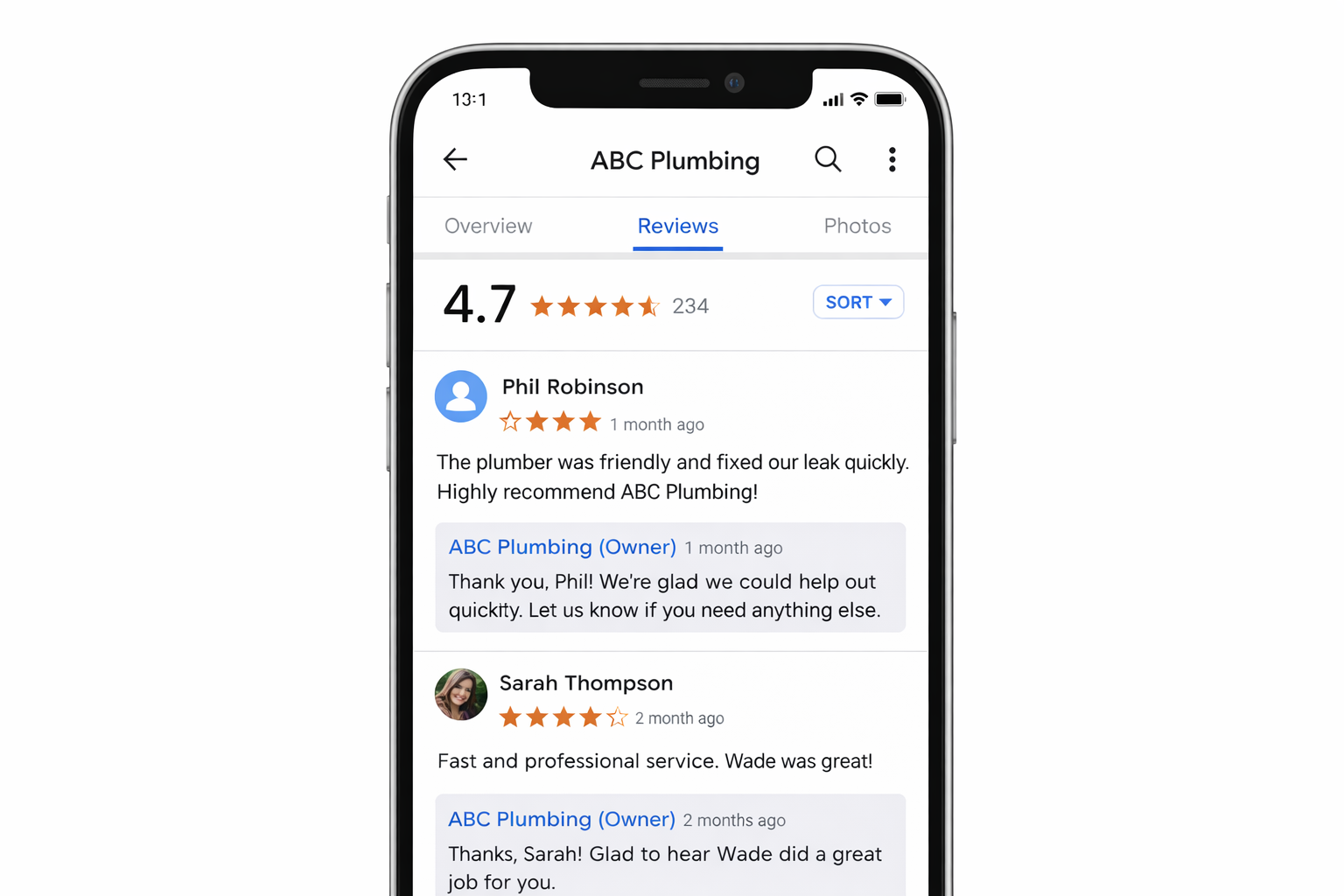
Gemini heavily favors Google Business Profiles, authoritative news sites, and platforms like Medium and Reddit. For local and commercial queries, having a well-optimized Google Business Profile is practically a prerequisite for Gemini visibility.
The Citability Checklist
Use this checklist to evaluate whether your content is built for AI citation. Rate each existing page against these criteria and prioritize the gaps.
1. Does it answer a specific question in the first 100 words? AI models scan the opening of a page to determine if it matches the query. A direct, concise answer near the top dramatically increases your chances.
2. Are headings descriptive and question-shaped? Vague headings don't help AI systems understand what a section covers. Use natural language headings that mirror how users phrase queries.
3. Does it include original data or unique information? Content that only rephrases what other sources already say gives AI no reason to cite you over those original sources. Proprietary data, case studies, and firsthand examples differentiate your page.
4. Is it structured with clear H2/H3 hierarchy? Flat content without heading structure makes it harder for AI to segment and extract specific claims. Use consistent heading hierarchy throughout.
5. Does it use schema markup? Article, FAQ, HowTo, and Organization schema help AI systems interpret your page's purpose and structure. SE Ranking research found that approximately 65% of pages cited by Google AI Mode include structured data markup.
6. Is it fresh? AI systems automatically add the current year into 28.1% of their sub-queries, even when users don't specify a date. Content updated within the last 30 days has been shown to earn significantly more citations. Keep publication dates accurate and update content substantively, not just cosmetically.
7. Are sources cited within the content itself? Pages that reference authoritative external sources, like industry reports, government data, or peer-reviewed studies, signal trustworthiness. Princeton research found that including authoritative citations increased visibility by over 31% when combined with other tactics.
8. Does it exist beyond your own site? AI models verify claims by cross-referencing across sources. If your brand and its claims appear only on your own domain, the model has low confidence in citing you. Third-party mentions on review sites, industry publications, Reddit, and YouTube create the corroboration AI needs.
Why Third-Party Mentions Matter as Much as Your Own Content
Your website is only one input. AI engines cross-reference what you say about yourself against what the rest of the internet says about you. Domains with profiles on platforms like Trustpilot, G2, Capterra, and similar review sites have three times higher chances of being cited by ChatGPT compared to sites without that presence. Brands with significant mention activity on Reddit and Quora see roughly four times higher citation rates.
This is where most content strategies fall short. Teams invest heavily in on-site content but neglect the ecosystem of third-party signals that AI models rely on to validate authority. Getting mentioned in industry publications, contributing to community discussions, and earning genuine reviews all feed into the citation decision.
How to Track Whether Your Content Gets Cited
Creating citation-worthy content is only half the work. You also need to know whether AI models are actually picking it up.
The simplest approach is manual testing. Identify 10 to 20 commercial prompts your potential customers would ask, then query ChatGPT, Perplexity, and Gemini with each one weekly. Record whether your brand appears, where it falls in the response, and which sources get cited instead of you.
For teams that need to scale this process, tools like RepuAI automate monitoring across multiple AI platforms. Instead of running manual queries and logging results in spreadsheets, you can track mention frequency, sentiment, and competitive positioning through a single dashboard. This is especially useful for identifying patterns: you might discover that AI consistently cites you for "enterprise solutions" queries but never for "small business" questions, which tells you exactly where to focus your content efforts.
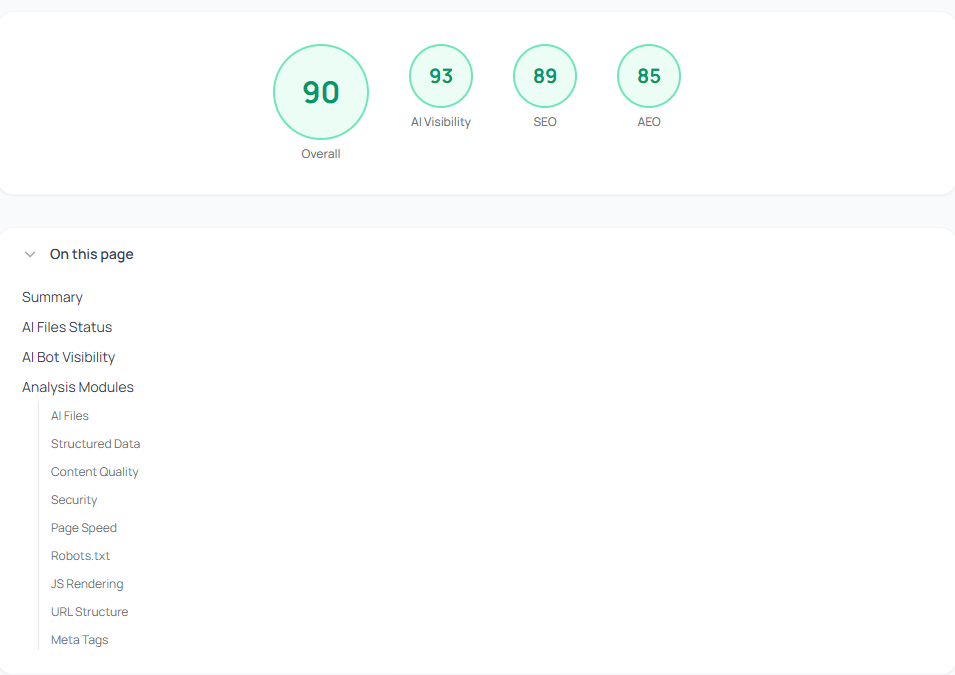
You can also check your site's current AI readiness using RepuAI's free AI Visibility checker, which analyzes how well your site is structured for AI search engines.
Content That Gets Ignored
Knowing what works is useful. Knowing what fails is just as important.
Promotional pages with thin information. AI models deprioritize content that reads like marketing copy. If a page is 80% sales messaging and 20% substance, it won't earn citations.
Long-form content without structure. A 5,000-word article with no headings, no lists, and no clear takeaways is nearly invisible to AI systems. Length alone doesn't earn citations. Structure does.
Outdated information. Stale pricing, discontinued features, or references to events from two years ago signal to AI models that your content can't be trusted for current queries.
Pages that only exist on your domain. If no other site on the internet corroborates what you're saying, AI models will pick a source that has external validation instead.
Start With One Page
You don't need to overhaul your entire site. Pick the page that targets your most important commercial query, the one where you'd most want to appear in an AI-generated answer. Run through the checklist above. Restructure it. Add original data. Front-load the answer. Add schema. Then test it across AI engines and track the results over time.
AI citation patterns are still forming. Brands that build citation-worthy content now are establishing positions that will compound as AI search traffic continues to grow. The window to act early is narrowing, but it's still open.
If you're looking to understand where your brand currently stands across AI search engines, RepuAI's site checker is a good starting point. And if you want to make sure your site is readable by AI crawlers, generating an llms.txt file can help AI models understand your brand's structure and offerings.
For more context on how AI search engines differ from traditional search and why this matters for your strategy, check out our guide on AI Search vs Google: What Marketers Need to Know in 2026. If you're new to the concept of optimizing for AI-generated answers, our complete guide to AEO in 2026 covers the fundamentals. And for a tactical playbook on making your content AI-friendly, our GEO practical guide walks through the full process.