SEO, AEO, and AI Visibility: The three metrics that define your Website's future
Learn how SEO, AEO, and AI Visibility scores work together to determine your website's performance in both traditional and AI-powered search engines. Discover free tools to check all three at once
If you still think SEO is the only number that matters for your website, you're playing last decade's game. The search landscape has shifted dramatically. People now get answers from ChatGPT, Perplexity, Gemini, and other AI assistants before they ever click a blue link on Google. And that changes everything about how we measure website performance.
There are now three scores every website owner should care about: SEO, AEO, and AI Visibility. Let me break down what each one means, why they matter, and how to track them all in one place.
What Is SEO (and Why It's No Longer Enough)
You probably know this one. SEO, or Search Engine Optimization, is the practice of making your website rank higher in traditional search results. It covers technical stuff like page speed, mobile-friendliness, meta tags, URL structure, and content quality.
SEO is still important. Google isn't going anywhere. But here's the problem: even if you rank #1 for a query, AI assistants might pull the answer from someone else's content and serve it directly to the user. The user never visits your page. Your ranking becomes invisible.
That's why SEO alone doesn't cut it anymore. You need to think about the full picture.
What Is AEO (Answer Engine Optimization)?
AEO is a newer concept that focuses on how well your content answers specific questions. Think of it as optimization for featured snippets, knowledge panels, and voice search results, but taken further into the AI era.
When someone asks Siri, Alexa, or a chatbot a question, the system looks for content that directly and clearly answers that question. AEO measures how well your site is structured to be that answer.
Key factors that influence your AEO score include structured data (schema markup), clear FAQ sections, concise and direct answers within your content, and proper heading hierarchy that makes it easy for machines to parse your information.
A high AEO score means your content is formatted in a way that answer engines can easily extract and present to users.
What Is AI Visibility?
AI Visibility is the newest and perhaps most critical metric of the three. It measures how likely your website or brand is to appear in responses generated by AI models like ChatGPT, Claude, Gemini, and Perplexity.
This goes beyond traditional crawling and indexing. AI Visibility depends on whether your content is accessible to AI crawlers (like GPTBot or ClaudeBot), whether your robots.txt allows or blocks these bots, whether your content is structured in a way that AI models can learn from, and whether your brand is mentioned across the web in contexts that AI training data would capture.
Unlike SEO, where you can see your rankings directly in Google, AI Visibility has been harder to measure. Until recently, there wasn't a straightforward way to get a score for it.
How These Three Scores Work Together
Think of it this way: SEO gets you found in Google. AEO gets your content selected as the direct answer. AI Visibility gets you mentioned when someone asks an AI assistant about your industry.
A site might score 89 in SEO but only 44 in AI Visibility. That means it ranks well in traditional search but is practically invisible to AI systems. Another site might have great AI Visibility at 93 but lag behind in SEO at 74. That site shows up in AI conversations but struggles in Google results.
The sweet spot is having all three scores balanced and high.
Measuring All Three: RepuAI Site Checker
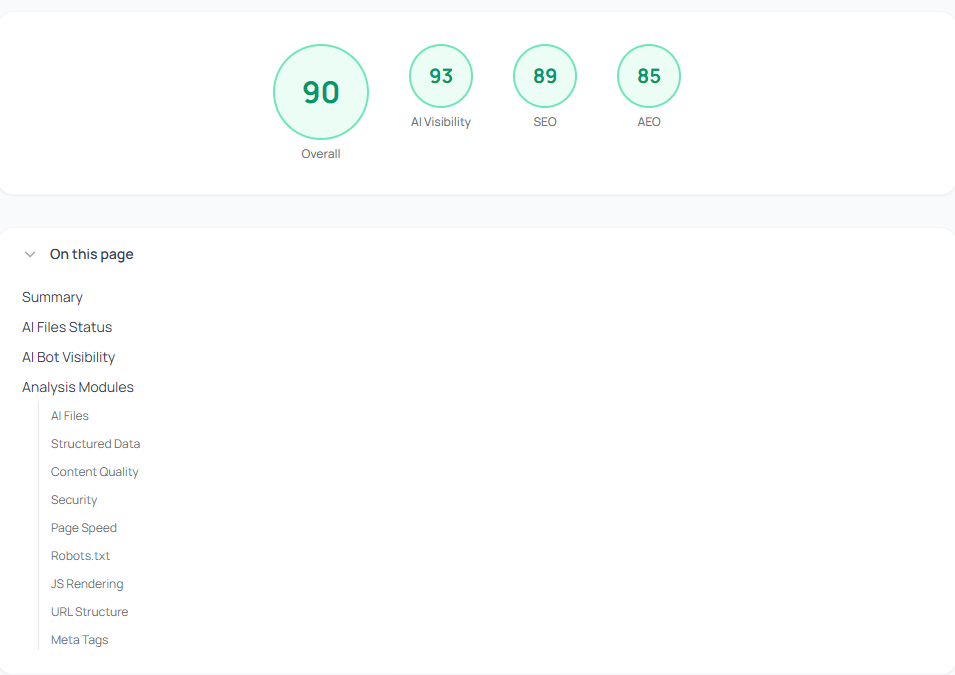
One of the tools I've found useful for tracking these metrics is the RepuAI Site Checker. It runs a comprehensive analysis and gives you four scores at a glance: an Overall score plus individual breakdowns for AI Visibility, SEO, and AEO.
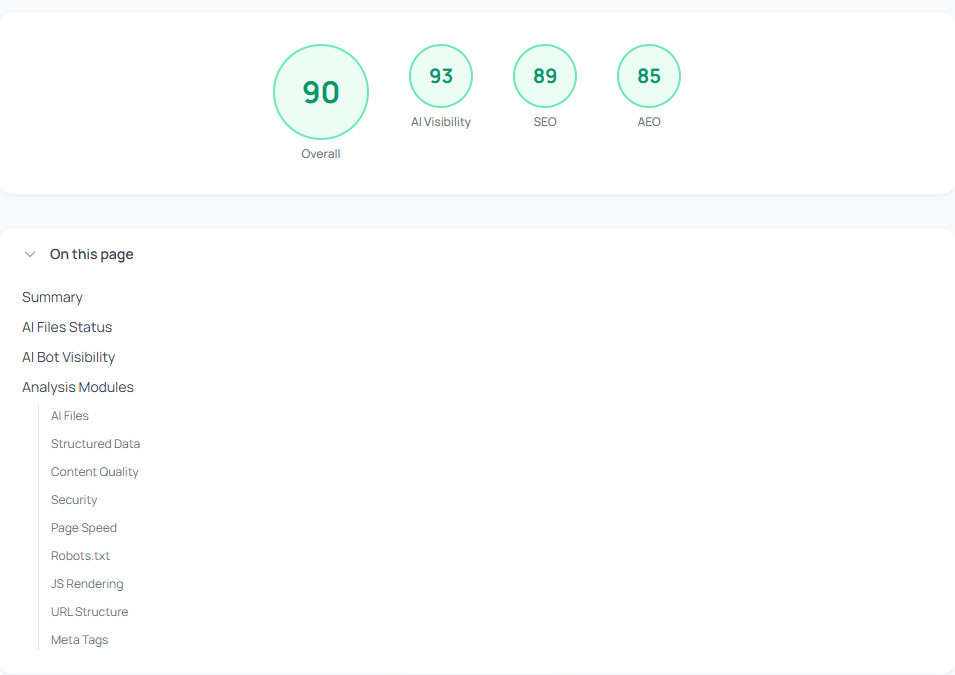
What I like about this tool is the depth of the analysis. Below the top-level scores, you get a full breakdown across multiple modules: AI Files status, Structured Data, Content Quality, Security, Page Speed, Robots.txt configuration, JS Rendering, URL Structure, and Meta Tags. Each module highlights specific issues and gives you actionable recommendations.
The report also checks AI Bot Visibility separately, which tells you exactly which AI crawlers can and cannot access your site. This is something most traditional SEO tools completely ignore.
What a Good Score Looks Like
Based on the reports I've seen on the platform, here's a rough benchmark. Scores above 85 across all three metrics put you in solid shape. Anything below 70 in any category means there's real work to do. And if your AI Visibility drops below 60, you're essentially invisible to a growing segment of how people search for information.
For context, the example in the screenshot above shows an Overall score of 90 with AI Visibility at 93, SEO at 89, and AEO at 85. That's a well-optimized site, though even with those numbers, the report identified 13 issues worth fixing.
No site is perfect. The goal is continuous improvement.
Quick Wins to Improve Each Score
For SEO: Focus on page speed, clean URL structures, proper meta tags, and mobile optimization. These are the basics, but so many sites still get them wrong.
For AEO: Add structured data markup to your pages. Create clear, concise answers to common questions in your niche. Use proper heading tags (H1, H2, H3) to create a logical content hierarchy.
For AI Visibility: Check your robots.txt file and make sure you're not blocking AI crawlers like GPTBot, ClaudeBot, or PerplexityBot. Create an llms.txt file that helps AI systems understand your site. Make sure your content is accessible without heavy JavaScript rendering.
The Bottom Line
The websites that will thrive in the next few years are the ones that optimize for all three dimensions of search: traditional, answer-based, and AI-powered. Ignoring any one of them means leaving traffic and visibility on the table.
If you haven't checked your scores yet, RepuAI's free site checker is a good starting point. Run the analysis, see where you stand, and start fixing the issues it flags. It takes about 15-30 seconds to get your report.
The search game has changed. Your optimization strategy should change with it.