Perplexity vs ChatGPT vs Gemini: How Each AI Engine Cites Brands
ChatGPT, Perplexity, and Gemini cite brands from completely different sources. Data from 6.8M citations reveals what each platform trusts and how to optimize
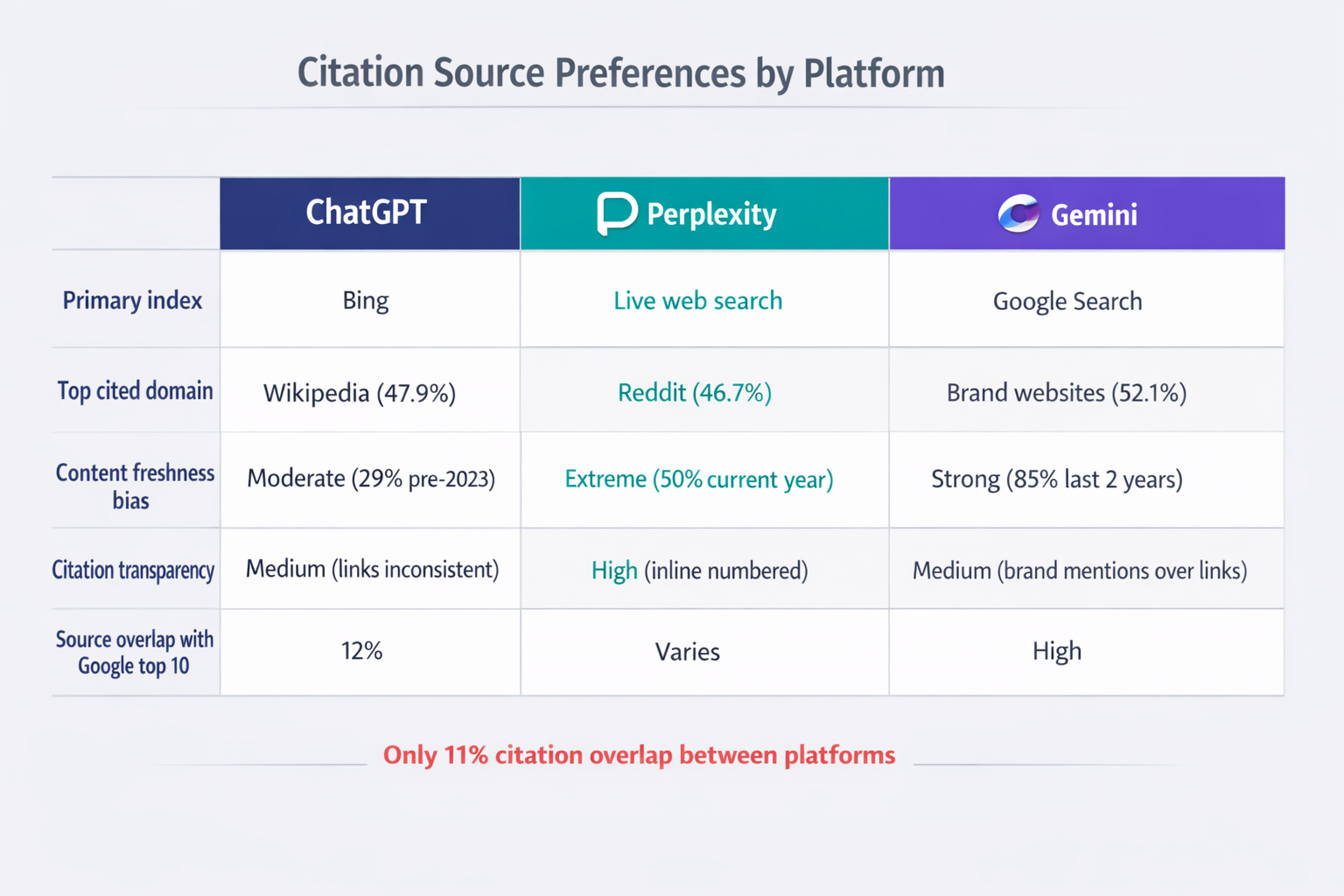
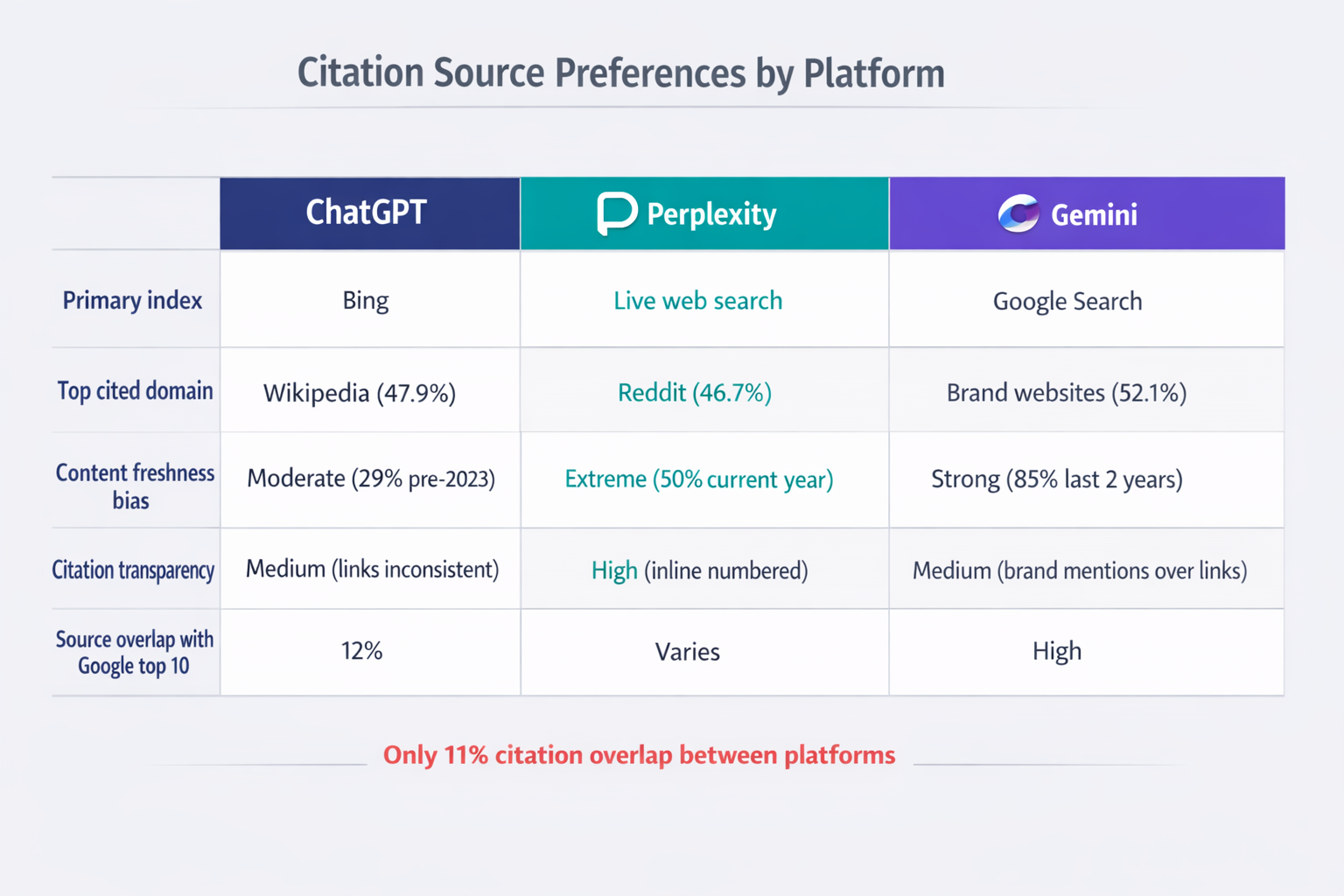
Optimizing for "AI search" as a single category is like optimizing for "social media" without distinguishing between LinkedIn and TikTok. The data on how ChatGPT, Perplexity, and Gemini actually source and cite brands shows three fundamentally different systems with minimal overlap.
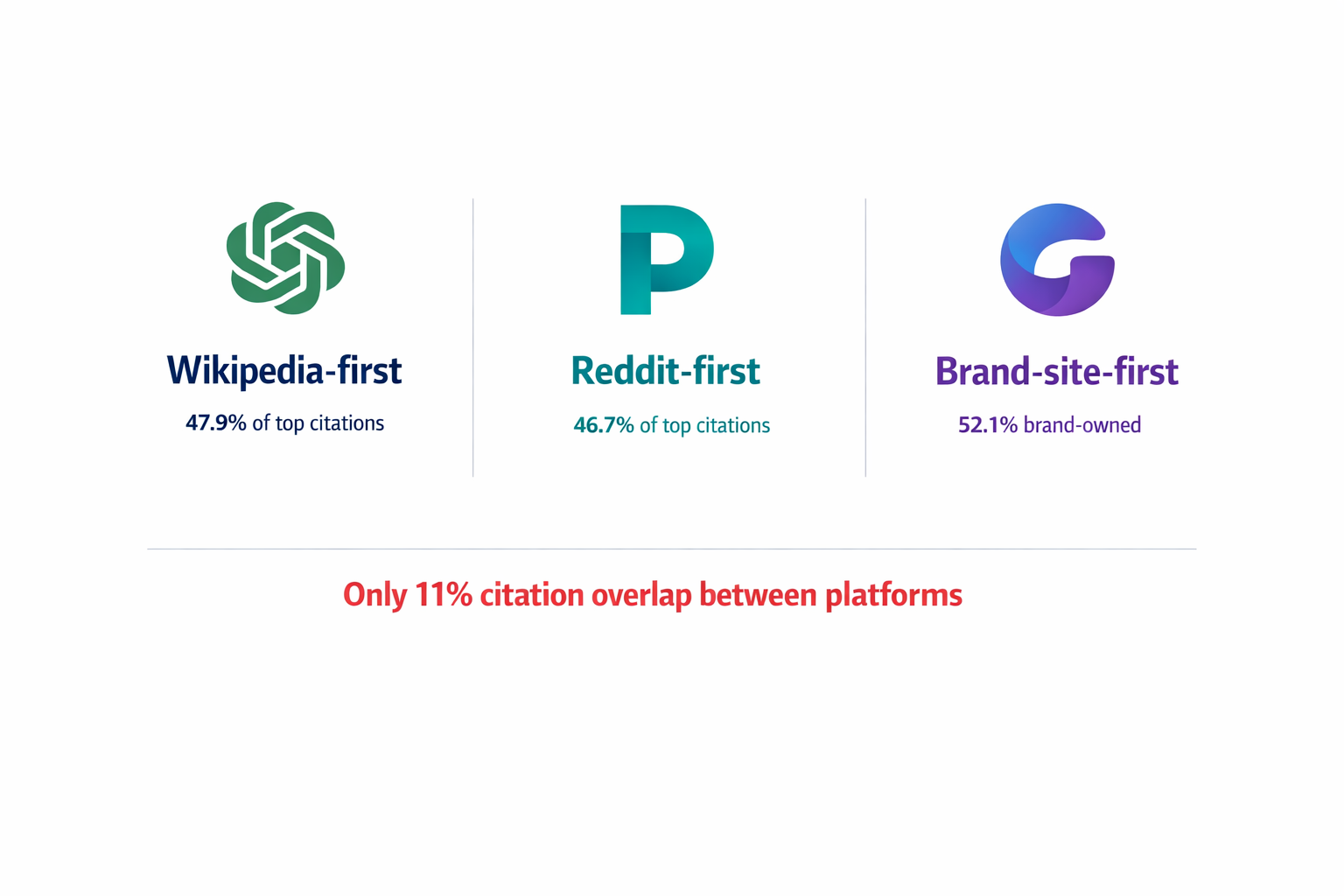
Only 11% of domains are cited by both ChatGPT and Perplexity. That's not partial overlap. That's two almost entirely separate ecosystems pulling from different sources, favoring different content types, and recommending brands through different logic.
This article breaks down exactly how each platform behaves, what sources they trust, and what you need to do differently for each one.
ChatGPT: The Wikipedia-and-Bing Engine
ChatGPT is the dominant AI platform with 883 million monthly users, processing 2 billion queries daily. It holds roughly 80% of the AI chatbot market share. But its citation behavior carries specific patterns that many marketers miss.
How ChatGPT sources information:
ChatGPT's citations match Bing's top 10 results 87% of the time. This is the single most important fact for ChatGPT optimization: if your content isn't indexed and ranking in Bing, ChatGPT is far less likely to cite you. Meanwhile, only 12% of URLs that ChatGPT cites also rank in Google's top 10. And 28.3% of ChatGPT's most-cited pages have zero Google organic visibility.
Among ChatGPT's top cited sources, Wikipedia accounts for 47.9% of citations within the top 10 most-referenced domains. Reddit follows at roughly 3-5% of total citation volume. Commercial .com domains make up over 80% of all ChatGPT citations by TLD.
ChatGPT's citation quirks:
ChatGPT references older content more heavily than other platforms. Research from Seer Interactive found that 29% of ChatGPT citations date back to 2022 or earlier, compared to much fresher citation profiles on Perplexity and AI Overviews. ChatGPT also provides clickable links in responses, but its sourcing skews toward a few large domains with less transparent inline attribution than Perplexity.
Sentiment data reveals something striking: ChatGPT's brand sentiment score averages 0.052 on a normalized scale, compared to Perplexity's 0.769. That's a 14.8x difference. Same brand, radically different editorial treatment depending on the platform.
How to optimize for ChatGPT:
Ensure your content is indexed in Bing (many sites neglect Bing entirely). Structure content with front-loaded answers: 44.2% of all LLM citations come from the first 30% of page text. Build Wikipedia and encyclopedic-style content with clear definitions, structured facts, and referenced claims. Maintain presence across broad third-party directories and listings, because ChatGPT rewards consistency across multiple sources for subjective queries.
Perplexity: The Reddit-and-Real-Time Engine
Perplexity processed 780 million queries in May 2025 and has crossed 15 million daily active users. It's the fastest-growing AI search platform with an 85% user return rate. Its citation mechanics differ dramatically from ChatGPT.
How Perplexity sources information:
Perplexity actively searches the web in real time for every query. It doesn't primarily rely on training data the way ChatGPT does. Every response is grounded in live web results, with inline numbered citations linking directly to sources. The Qwairy study of 118,101 AI-generated answers found that Perplexity cites nearly 9x more sources per response than Microsoft Copilot.
Reddit dominates Perplexity's citation profile at 46.7% of its top 10 sources. This reflects Perplexity's heavy reliance on community-generated, discussion-format content. YouTube and LinkedIn also appear prominently. Perplexity uses a more diverse source set than ChatGPT: more user-generated content, more niche publications, more regional sources.
50% of Perplexity citations are content published in the current year, reflecting an extreme recency bias. If your content is older than 12 months, Perplexity is far less likely to cite it.
Perplexity's citation quirks:
Perplexity cites Claude's citations match Brave Search results 86.7% of the time, and Perplexity itself pulls from a variety of indexes. It leans into industry-specific directories rather than general listings. In healthcare, Zocdoc drives Perplexity citations. In hospitality, TripAdvisor dominates. For subjective queries, niche sources make up 24% of all Perplexity citations.
The platform offers balanced mention-and-citation ratios, making it potentially more valuable for driving actual traffic. When Perplexity cites you, users can actually click through and find you. ChatGPT will talk about your brand but often won't send users to you with a link.
How to optimize for Perplexity:
Content freshness is non-negotiable. Update key pages at least every 60 days (pages updated within 60 days are 1.9x more likely to appear in AI answers). Build authentic presence on Reddit in relevant subreddits, because Reddit is Perplexity's most-cited domain. Invest in niche, industry-specific directories rather than generic listings. Structure content as Q&A with clear, quotable answers per section.
Gemini: The Brand-Site-First Engine
Google's Gemini (powering both direct Gemini chat and AI Overviews) reached 400 million monthly active users by mid-2025. It now powers 27% of assisted-query interactions within Google Search itself. Its citation behavior is the most distinct of the three.
How Gemini sources information:
Gemini behaves more like a traditional search engine with stricter sourcing standards. Yext's analysis of 6.8 million citations found that 52.15% of Gemini citations come from brand-owned websites. This is dramatically different from ChatGPT (which favors Wikipedia) and Perplexity (which favors Reddit). Gemini trusts what brands say about themselves, as long as the content is structured, factual, and includes proper schema markup.
AI Overviews show the strongest brand preference at 59.8% of citations, compared to 44.7% for ChatGPT and 28.9% for Perplexity. Google also provides the highest number of clickable link citations. But there's a catch: AI Overviews only trigger about 33% of the time, and the zero-click rate in AI Mode hits 93%.
Among AI Overview top cited sources, YouTube takes 23%, Wikipedia 18%, and Google.com itself 16%.
Gemini's citation quirks:
Gemini handles prompts differently based on type. GenOptima's March 2026 analysis found that Gemini triggers web search for 100% of informational prompts ("how to," "best practices," "techniques") but 0% of recommendation prompts ("recommend 10 companies"). For brand recommendation queries, Gemini relies entirely on its existing knowledge and training data rather than searching the web. This means your brand needs to be embedded in Gemini's understanding through structured data and knowledge graph presence, not just through recent web content.
85% of AI Overview citations were published in the last two years, with 44% from the current year. Content freshness matters here, though not as extremely as with Perplexity.
How to optimize for Gemini:
Prioritize your own website content with comprehensive schema markup (Article, Product, FAQ, Organization). Gemini rewards brand-owned content over third-party sources more than any other platform. Ensure your Google Business Profile is complete and accurate. Maintain an active YouTube presence, because YouTube is the most-cited domain in AI Overviews. Build strong entity clarity in Google's Knowledge Graph through consistent NAP data, Wikidata entries, and structured information architecture.
The Practical Framework: Platform-Specific vs Universal Tactics
Some tactics work everywhere. Others need platform-specific execution.
Universal tactics (do these regardless):
Front-load answers. Put your clearest, most citable statements in the first 30% of every page. Structure content with headings, lists, and Q&A format. This is the most effective format for non-question queries across all platforms. Include statistics, citations, and direct quotations. Content with these elements achieves 30-40% higher visibility in AI responses. Update content frequently. Pages updated within 60 days earn 28% more citations than older content.
Platform-specific priorities:
For ChatGPT: Get indexed in Bing. Build Wikipedia-style encyclopedic content. Ensure broad directory presence. Focus on content depth over freshness.
For Perplexity: Maintain extreme content freshness. Build Reddit presence. Target niche industry directories. Optimize for inline citation format with clear, quotable paragraphs.
For Gemini: Invest in brand-owned content with full schema markup. Prioritize Google Business Profile. Create YouTube content. Build Knowledge Graph presence. Focus on informational content over recommendation-style content.
Why Multi-Platform Monitoring Matters
The sentiment gap between platforms can be 14.8x for the same brand. Citation volumes can differ by 615x between platforms like Grok and Claude. AI visibility can drop 35% in five weeks if you're not watching. A brand can lose a third of its AI presence in just over a month.
This volatility, combined with the massive differences in how platforms source information, makes single-platform monitoring dangerously incomplete. You need to see how ChatGPT, Perplexity, and Gemini each represent your brand independently.
That's exactly what RepuAI was designed for: simultaneous monitoring across ChatGPT, Perplexity, Gemini, and Claude. You can track mention rates, sentiment, citation accuracy, and competitive positioning for each platform separately, so you know where you're winning and where you're invisible. Start with a free AI visibility scan to see your current cross-platform standing.
For the foundational optimization tactics that apply across all platforms, our GEO guide covers the full spectrum. To understand the specific metrics you should track, see our AI visibility measurement framework. And if you're exploring how AI agents (not just AI search) change the visibility game, our agentic AI guide covers the next layer.
The Bottom Line
Gemini trusts what your brand says about itself. ChatGPT trusts what the broader internet agrees on. Perplexity trusts industry experts and community discussions. Three different trust models, three different optimization playbooks.
The brands winning AI visibility in 2026 aren't treating "AI search" as one thing. They're running platform-specific strategies that match content architecture to each engine's citation patterns. And they're monitoring all three simultaneously, because what's true on Perplexity might be completely different on ChatGPT.