Agentic AI and Brand Visibility: What Marketers Need to Know
AI agents now research, compare, and buy products without human input. Learn how agentic AI changes brand visibility and what to do to stay discoverable
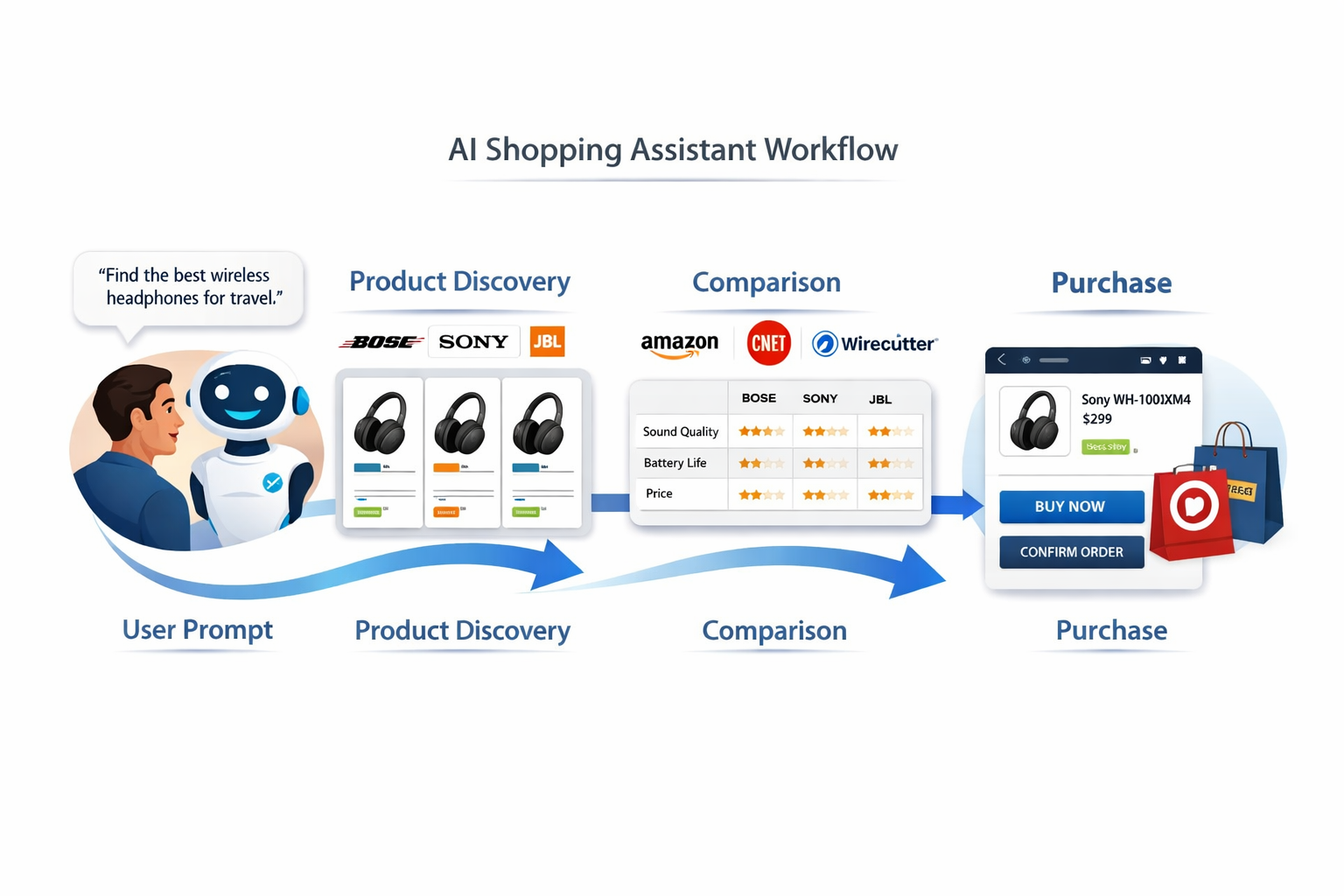
A shopper asks an AI assistant to find a birthday gift under $50 that arrives by tomorrow. The agent evaluates dozens of options, checks reviews across Reddit and third-party sites, compares prices, and places the order. The shopper never opens a browser, never visits a product page, never sees your brand's homepage. If your product data wasn't structured for that agent to parse, you didn't exist in that transaction.
This is agentic AI in action. And it's already reshaping how brands get discovered, evaluated, and chosen.
What Is Agentic AI and Why Should You Care?
Agentic AI refers to autonomous systems that don't just answer questions. They plan, decide, and execute multi-step tasks on behalf of users. Where traditional AI search (ChatGPT, Perplexity, Gemini) generates a text response with citations, agentic AI goes further: it researches, compares options, applies user preferences, and can complete a purchase without the user leaving the conversation.
The distinction matters for marketers. Traditional AI search asks: "Does this brand appear in the answer?" Agentic AI asks something harder: "Can an AI agent find, understand, and act on this brand's data?"
Here's what's already live in early 2026:
Google announced its Universal Commerce Protocol (UCP) at NRF in January 2026, developed with Shopify, Etsy, Wayfair, Target, and Walmart. Wayfair and Etsy already allow purchases directly within Google's AI Mode. OpenAI introduced shopping research in ChatGPT using GPT-5 mini, with comparative product guides and real-time feedback loops. Perplexity launched conversational product discovery with instant checkout powered by PayPal. Amazon made Alexa+ fully available to all US users in February 2026, free for its 250 million Prime members. Early data showed users tripled their shopping activity compared to the original Alexa.
These aren't experiments. They're live products serving hundreds of millions of users.
The Numbers Behind the Shift
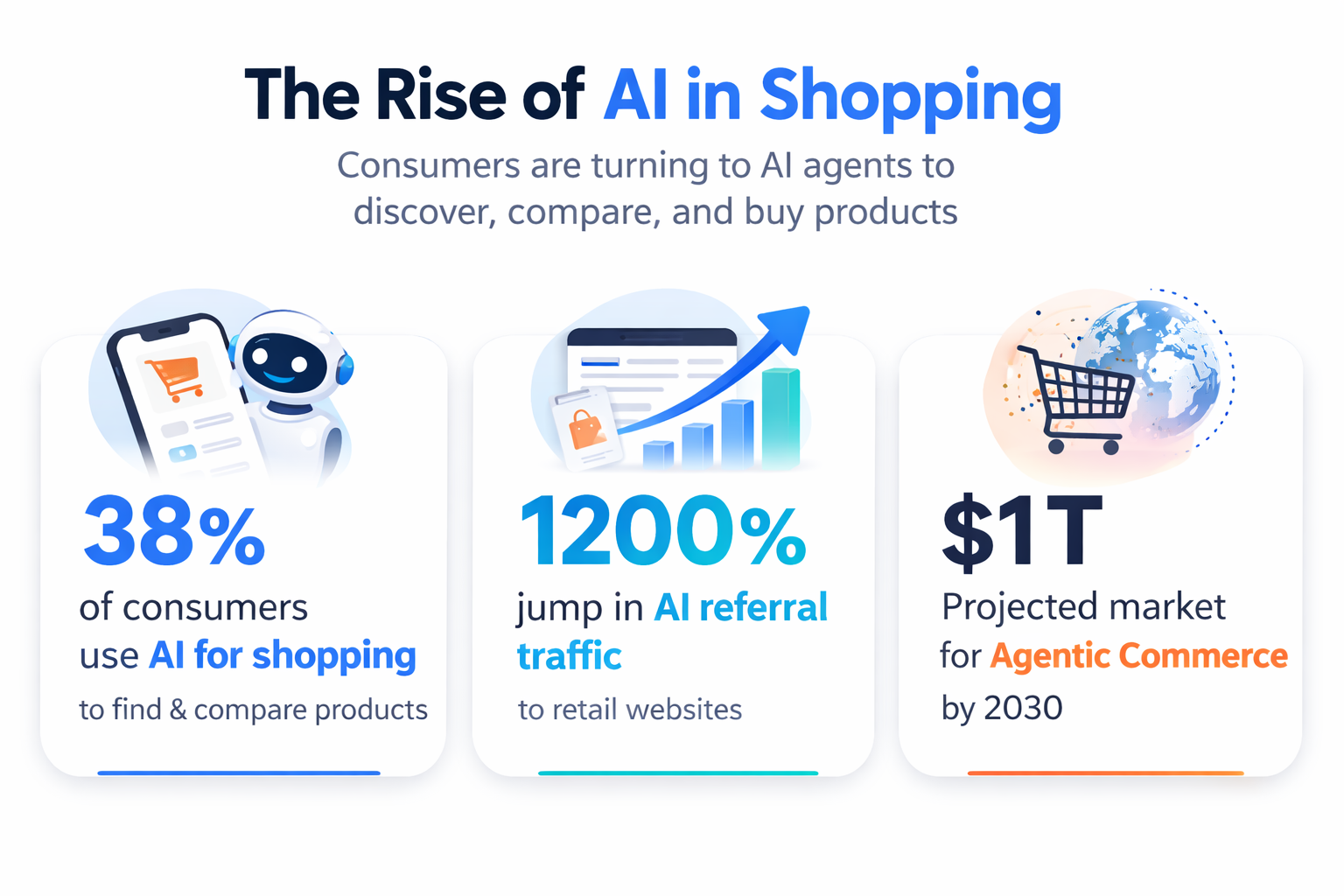
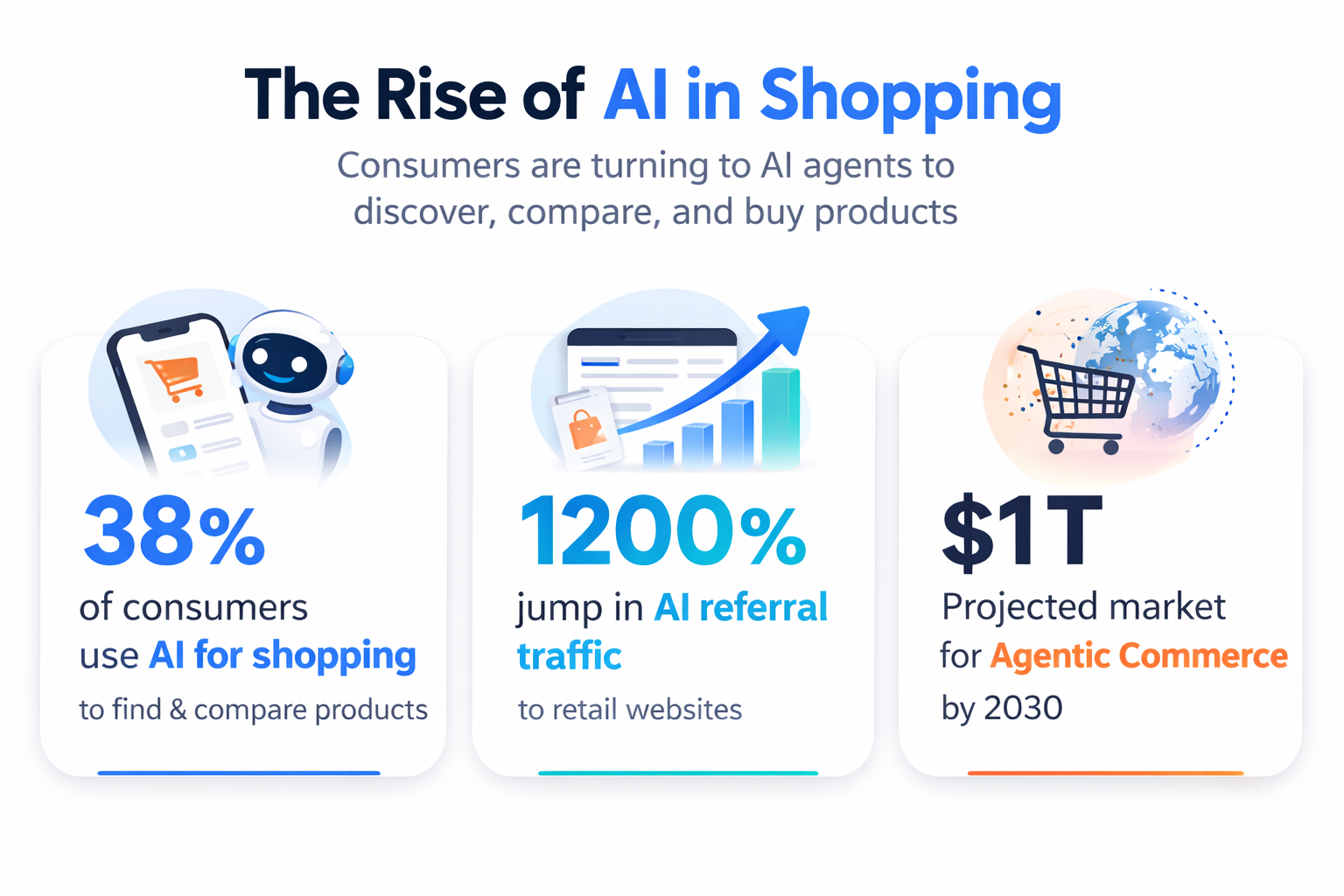
The scale of this transition is hard to overstate. According to Bain & Company, 30% to 45% of US consumers already use generative AI for product research and comparison. IAB found that 38% of consumers use AI when shopping, and 80% expect to increase that usage. Morgan Stanley projects that nearly half of online shoppers will use AI shopping agents by 2030, accounting for roughly 25% of their spending. McKinsey estimates the US B2C retail market alone could see up to $1 trillion in revenue orchestrated through agentic commerce by 2030, with global projections reaching $3 to $5 trillion.
Adobe's Digital Economy Index reported that traffic from AI sources jumped 1,200% for retailers. And according to PYMNTS Intelligence, as of January 2026, 41% of consumers have used dedicated AI platforms for product discovery, with 33% saying they've fully replaced their prior methods.
This isn't a future trend. It's a present reality with accelerating adoption.
How Agentic AI Changes the Visibility Game
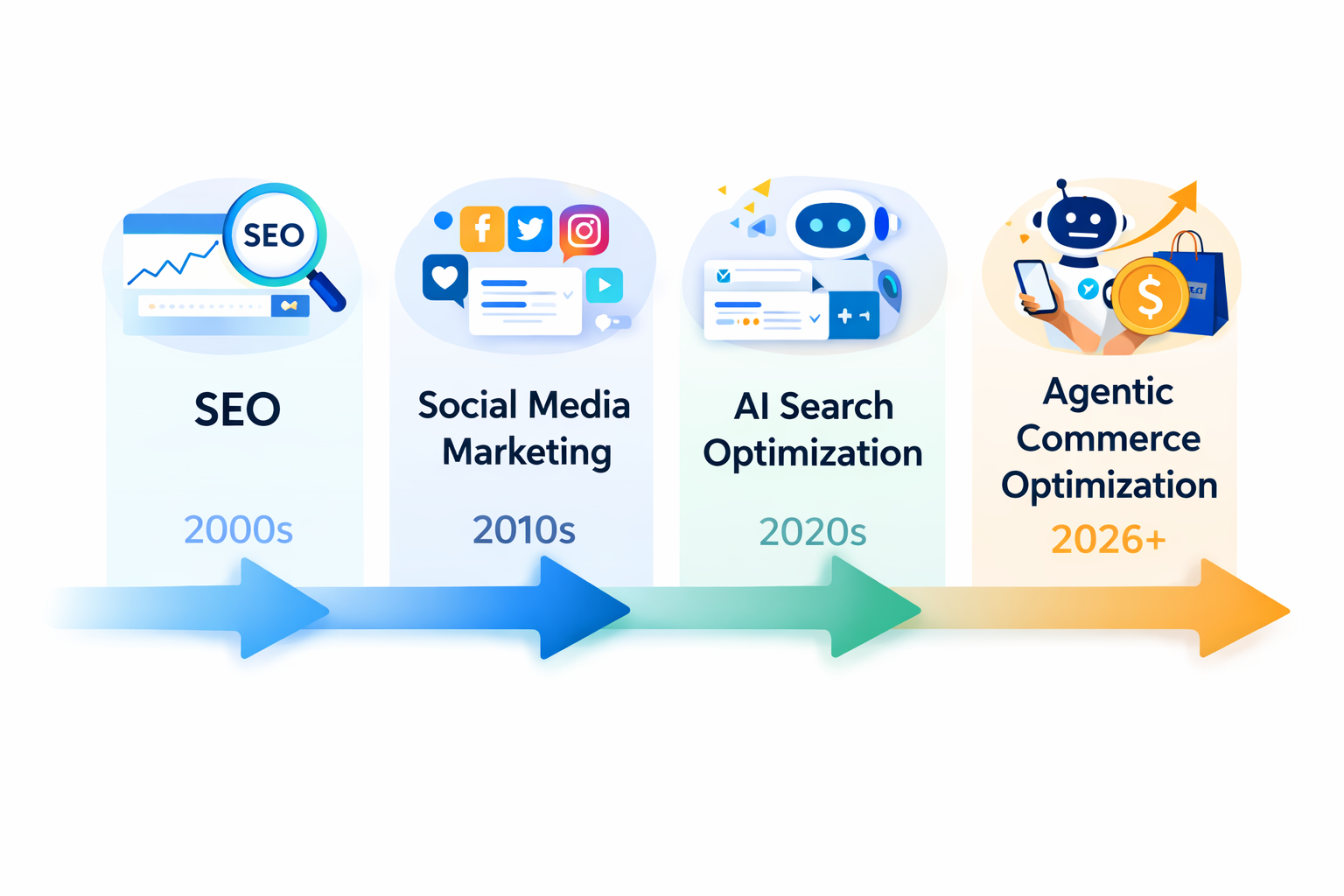
Traditional SEO optimized for humans clicking through search results. GEO (Generative Engine Optimization) optimized for being cited in AI-generated text responses. Agentic AI introduces a third layer: your brand needs to be machine-readable, parseable, and actionable by autonomous systems that may never show a user your website.
Here's what changes practically:
Discovery shifts from search results to agent recommendations. An AI agent researching kitchen appliances doesn't browse ten product pages. It scrapes structured data, reads reviews from Reddit and independent publications, cross-references citations from authoritative sources, and delivers a recommendation. If your brand's content isn't structured for machine parsing, the agent skips you.
The buyer journey compresses dramatically. What used to take multiple sessions across days now happens in a single AI conversation. Pinterest's VP of Product Marketing, Julie Towns, noted that agentic AI will have the biggest impact on planning-driven, repeatable decisions: outfits, home furnishings, gifts, seasonal refreshes, weekly grocery shopping. The "consideration" stage where brands traditionally invested in content marketing is collapsing into seconds.
Brand loyalty gets filtered through AI logic. When a customer delegates a purchase decision to an agent, that agent evaluates based on data signals, not brand affinity. Materials, durability, price, availability, reviews, and structured attributes matter more than brand storytelling. Your brand story still matters for building the authority signals that AI trusts, but the final selection increasingly runs through algorithmic logic.
Backend systems determine visibility, not front-end design. The new battleground isn't how your homepage looks. It's whether your product data, APIs, pricing, and inventory information are accessible and parseable by AI agents. If an agent can't query your catalog in real time, you're invisible in the agentic layer.
A Practical Framework: Making Your Brand Agent-Ready
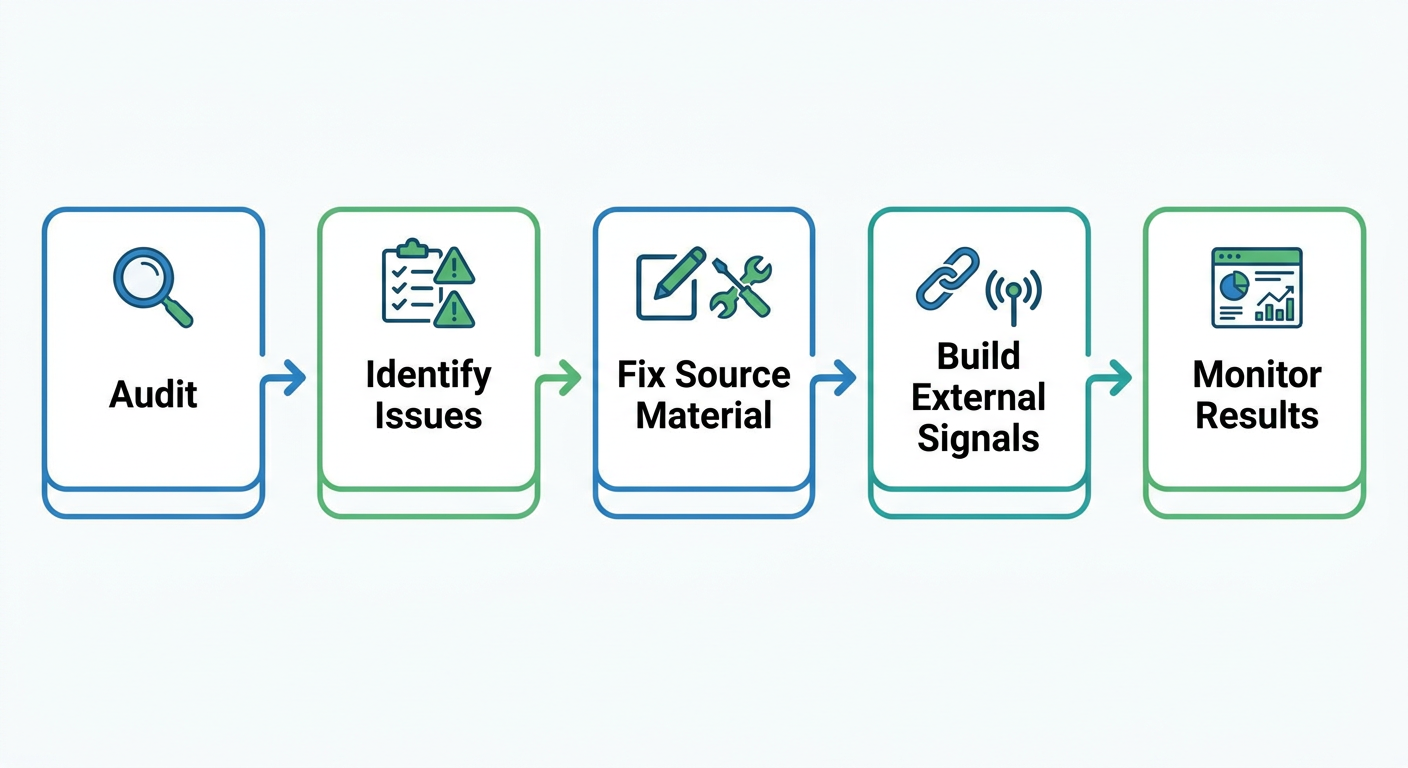
Preparing for agentic AI doesn't require rebuilding your entire digital presence. But it does require specific actions that most brands haven't taken yet. Here's a prioritized framework:
1. Audit Your Structured Data
AI agents rely heavily on schema markup to understand your content. At minimum, implement JSON-LD for Article, Product, FAQ, Organization, and Review schemas. Go beyond the basics: include product attributes like compatibility, materials, size ranges, and use-case descriptions. Google's new Merchant Center attributes for conversational commerce specifically require answers to common product questions, compatible accessories, and substitutes.
2. Make Your Product Data Agent-Parseable
Clean, complete product catalogs are non-negotiable. Every product needs accurate pricing, real-time availability, detailed specifications, and high-quality images with descriptive alt text. If you're on Shopify, their Agentic Plan and Shopify Catalog already syndicate products to AI platforms. For other platforms, ensure your product feeds are API-accessible and up to date.
3. Build Entity Clarity
AI agents need to understand what your brand IS before they can recommend it. Ensure your brand is clearly defined across knowledge graphs. Claim and optimize your Google Business Profile, ensure accurate Wikidata entries where applicable, maintain consistent NAP (name, address, phone) data across directories, and build a strong entity footprint through authoritative third-party mentions.
4. Optimize for Citation-Worthiness
Agents pull recommendations from sources they trust. That means your content needs to appear on third-party review sites, industry publications, and platforms like Reddit where AI models frequently source information. Earned media, expert roundups, and genuine customer reviews all feed the trust signals that determine whether an agent cites your brand.
5. Configure Your Robots.txt for AI Crawlers
Make sure you're not accidentally blocking AI agents. Review your robots.txt settings for GPTBot, OAI-SearchBot, Google-Extended, ClaudeBot, and PerplexityBot. Each has different crawling behaviors, and blocking them means blocking your brand from AI-generated recommendations.
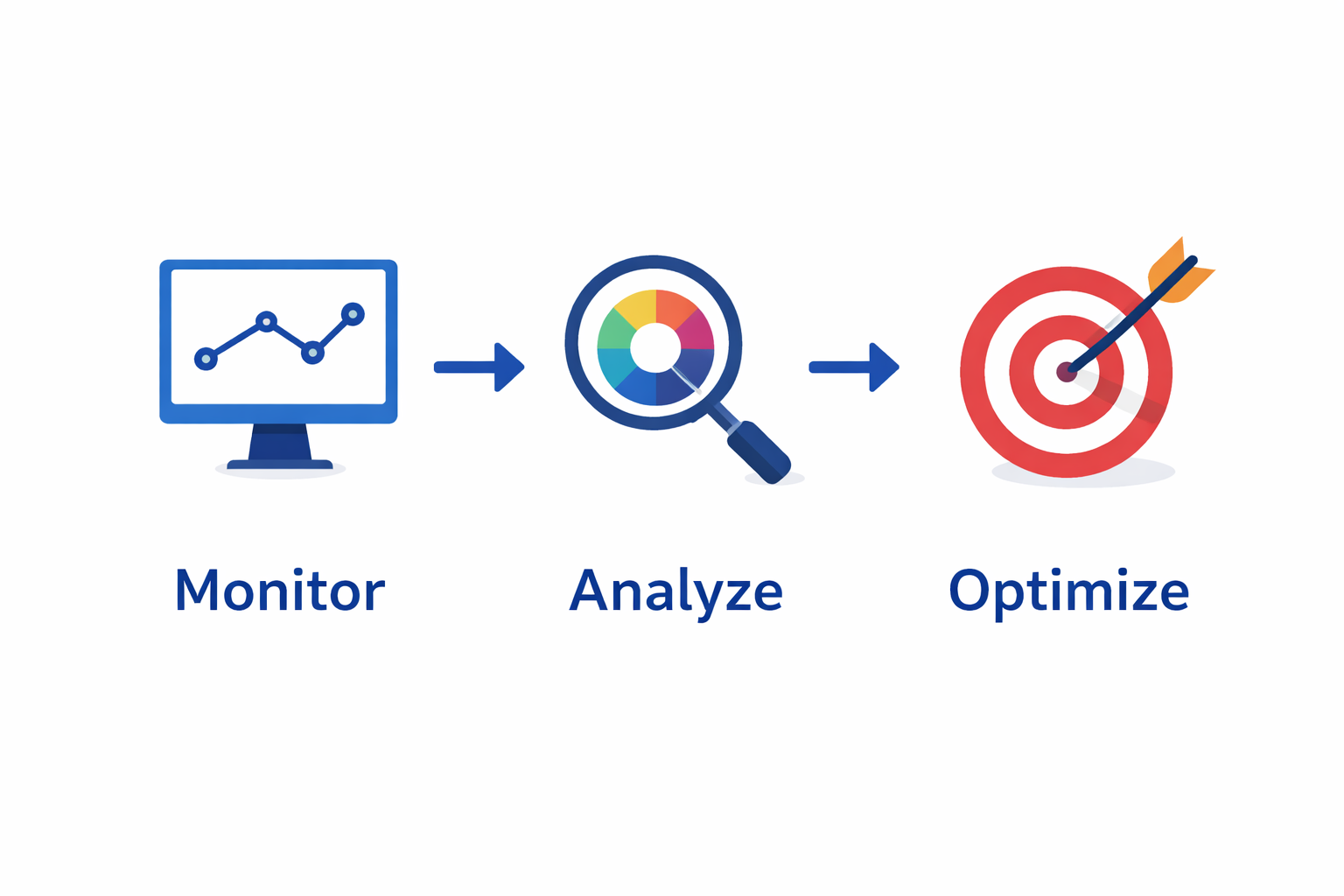
6. Monitor How AI Agents Perceive Your Brand
This is where most brands have a blind spot. You might rank well in Google, you might even appear in ChatGPT's text responses, but you have no idea how an AI shopping agent represents your products. Is it citing accurate pricing? Correct product attributes? Positive or negative sentiment? Without monitoring, you're flying blind.
What Agentic AI Means for Different Business Types
The impact varies significantly depending on your business model:
E-commerce brands face the most immediate pressure. If AI agents can't access your product data, parse your pricing, and verify your inventory in real time, you're excluded from a growing share of purchase decisions. Start with structured data and product feed optimization.
SaaS companies need to think about how AI agents evaluate and compare software solutions. When a user asks an agent to "find the best project management tool for a 10-person remote team under $20/month," the agent is pulling from comparison articles, review sites like G2 and Capterra, and product pages. Your positioning on these platforms directly affects agentic recommendations.
Service businesses (agencies, consultants, local services) should focus on entity optimization and local visibility signals. AI agents answering "find a reliable plumber in Austin" are synthesizing Google Business Profile data, reviews, and local directory information.
B2B companies have a longer runway but shouldn't wait. Agentic AI is already automating procurement workflows, approval processes, and vendor comparisons in enterprise settings. Forrester predicts that by 2026, one in five B2B sellers will need to respond to AI-powered buyer agents with dynamically delivered counteroffers.
The Trust Problem That Hasn't Been Solved
Here's an important counterpoint. Despite the momentum, full consumer trust in agentic AI isn't there yet. IAB data shows only 46% of shoppers fully trust AI recommendations, and 89% still verify the information before purchasing. For high-stakes purchases, people want to stay in the loop.
This creates an opportunity. Brands that establish themselves as trusted, authoritative sources now will be the default recommendations when consumer comfort catches up with the technology. The brands that AI agents learn to trust today will compound that advantage over years.
Harvard Business Review recently highlighted a case where Pernod Ricard discovered AI models were miscategorizing one of their whiskey brands as a prestige product when it was actually an affordable mass-market offering. This kind of misrepresentation isn't theoretical. It's happening across categories, and most brands don't even know about it.
Where RepuAI Fits In
The challenge with agentic AI is visibility into what's actually happening. You can optimize your structured data, build entity clarity, and earn citations, but how do you know whether AI agents are actually recommending your brand? What sentiment are they associating with your products? Are they citing accurate information or propagating outdated data?
RepuAI was built to answer exactly these questions. It tracks how your brand appears across AI search engines, including ChatGPT, Perplexity, Gemini, and Claude. You can monitor mention frequency, sentiment, citation accuracy, and how your brand is positioned relative to competitors in AI-generated responses.
For brands preparing for agentic commerce, this kind of monitoring isn't optional. It's the feedback loop that tells you whether your optimization efforts are actually working. You can start with a free AI visibility check to see where your brand currently stands.
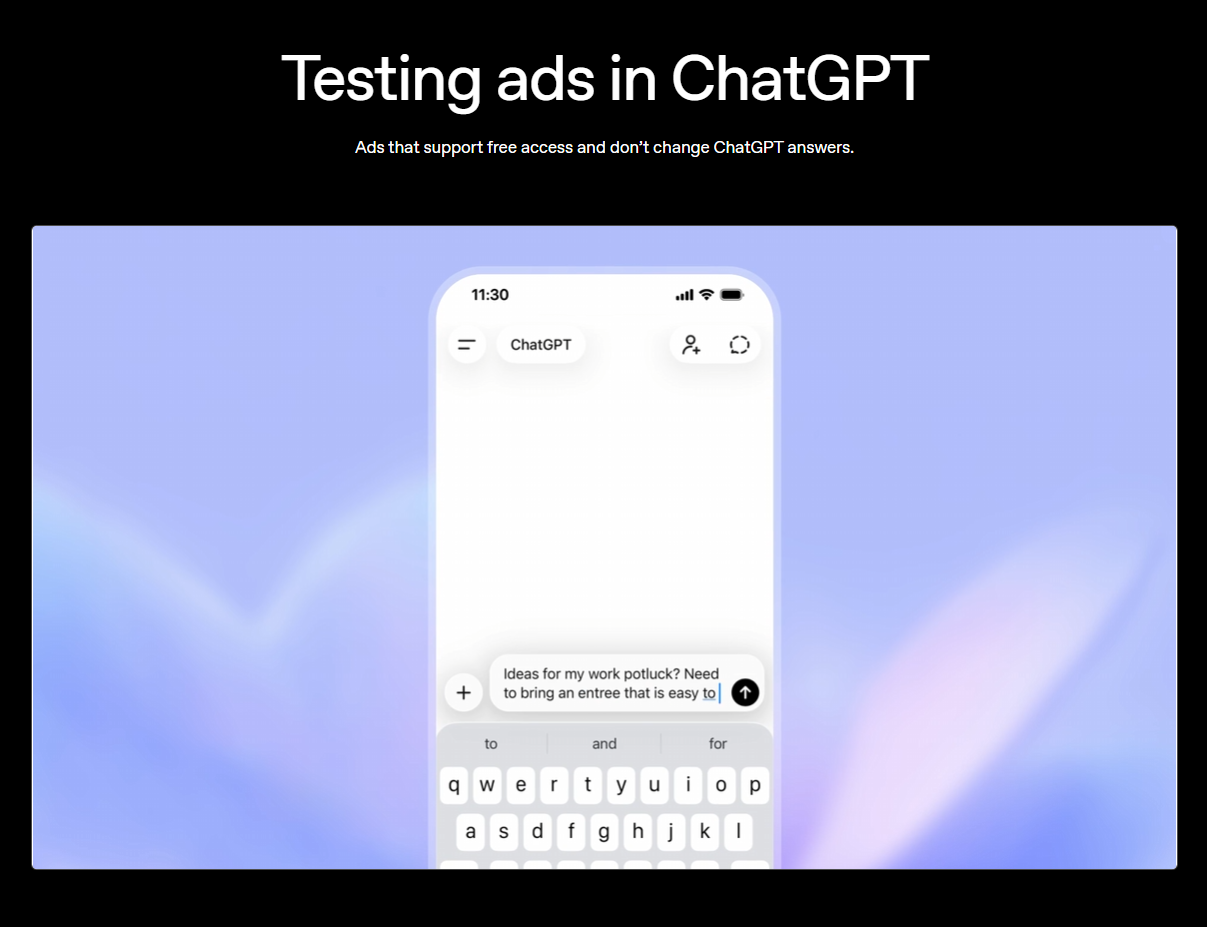
The shift to agentic AI also connects to broader trends we've covered on this blog. If you haven't already, it's worth reading about how ChatGPT ads affect organic visibility and what types of content get cited by AI search engines. Understanding citation patterns becomes even more critical when agents are making autonomous decisions based on those citations. Our GEO guide also provides tactical foundations that apply directly to agentic optimization.
What Comes Next
The agentic commerce ecosystem is still forming. Protocols like Google's UCP and OpenAI's Agentic Commerce Protocol are being developed in real time. Payment integrations, security frameworks, and standardized product data formats are all works in progress. But the trajectory is clear.
The brands that invested early in SEO twenty years ago captured outsized organic traffic for years. The brands that invested early in social media marketing built audiences before acquisition costs skyrocketed. Agentic AI is the next version of that pattern. The window for establishing your brand in this new layer of discovery is open now, but it won't stay open forever.
Start with the fundamentals: structured data, clean product information, entity clarity, and AI visibility monitoring. Then build from there. The brands that treat agentic AI as a strategic priority rather than a future concern will define the next era of digital commerce.