How to Track Your Competitors in AI Search
Learn how to track competitors in AI search engines like ChatGPT and Perplexity. A step-by-step framework with metrics, prompt maps, and templates

Your biggest competitor just got recommended by ChatGPT for the exact query your customers type every day, and you had no idea until a prospect mentioned it on a sales call.
This is the new blind spot in marketing. Traditional competitive intelligence tracks ad spend, keyword rankings, and social mentions. None of that tells you what happens when a buyer asks Perplexity "what's the best [your category] tool?" and your competitor's name comes out of the AI's mouth instead of yours.
AI search competitive analysis isn't optional anymore. It's the difference between knowing you're losing market share and watching it happen in real time. This guide gives you a repeatable framework for tracking how competitors show up across ChatGPT, Perplexity, Gemini, Claude, and Google AI Overviews, along with the metrics that actually matter.
Why Traditional Competitive Analysis Misses AI Search
You probably already track competitor keywords in Ahrefs or Semrush. You might monitor their social media, review new landing pages, or subscribe to their newsletter. That covers the Google-era playbook. But AI search engines operate on a completely different logic.
When someone asks ChatGPT for a product recommendation, the model doesn't return a ranked list of URLs. It synthesizes information from its training data and real-time web retrieval, then names specific brands in a conversational answer. There's no page two. There's no "also ranking" position. You're either mentioned or you don't exist.
Here's what makes this particularly dangerous: AI responses are inconsistent. Research from SparkToro found that there's less than a 1 in 100 chance ChatGPT will produce the same brand list twice for an identical query. Your competitor might appear in 7 out of 10 responses while you show up in 3. Without systematic tracking, you'd never know.
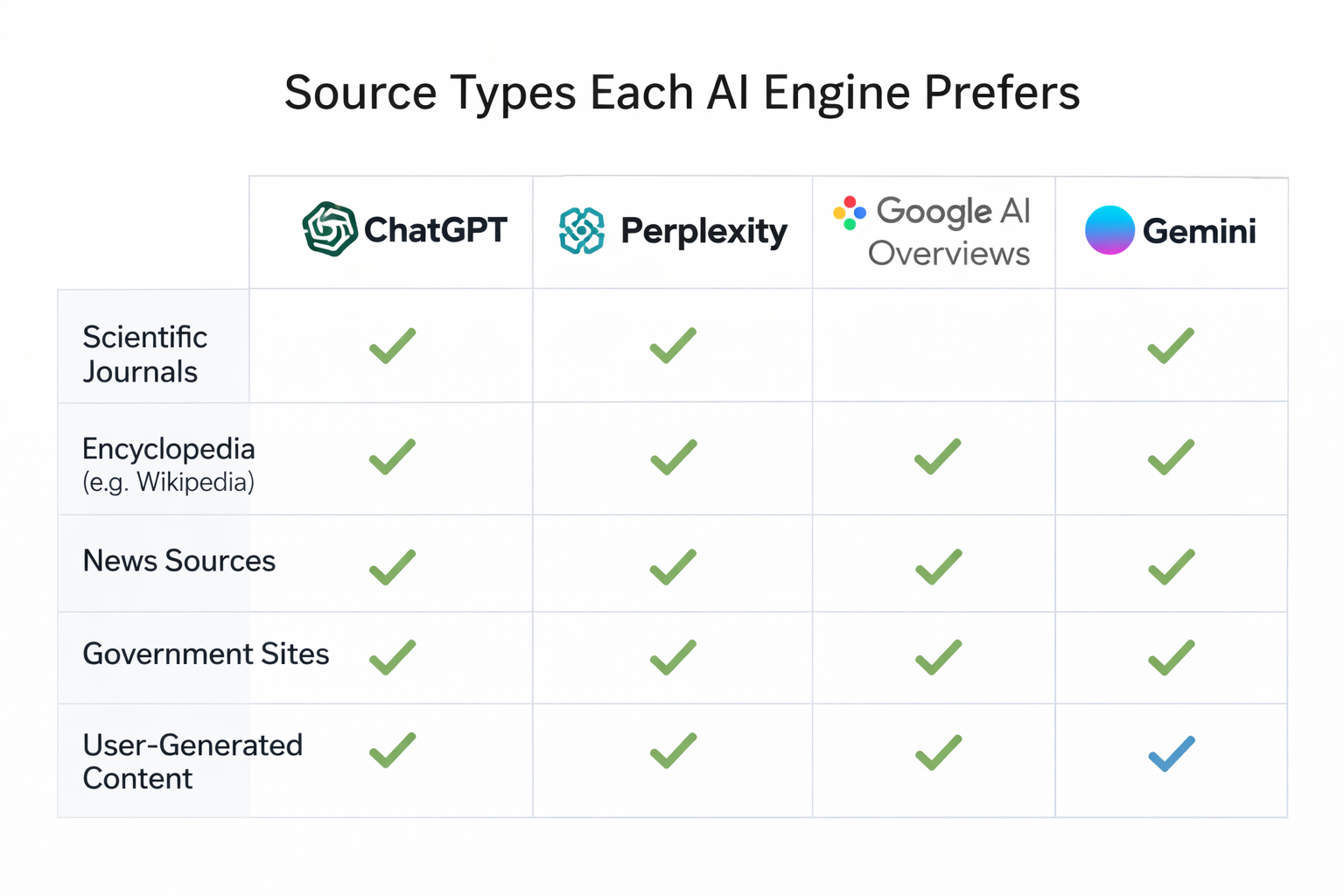
Three factors widen the gap between traditional and AI competitive intelligence. First, AI models pull from different source ecosystems than Google. ChatGPT leans on Wikipedia, LinkedIn, and G2. Perplexity favors Reddit and YouTube. Gemini prioritizes Google Business Profiles. A competitor dominating one source ecosystem can own an entire AI platform without strong Google rankings.
Second, sentiment matters as much as presence. BrightEdge's March 2026 research revealed that ChatGPT concentrates negative brand sentiment 13 times more heavily near the point of purchase than Google AI Overviews. Your competitor might get mentioned more often, but with caveats that hurt their conversion, creating an opening you'd miss without sentiment tracking.
Third, AI platforms disagree on who to recommend 73% of the time. Monitoring a single platform gives you a distorted picture.
The Four Metrics That Define AI Competitive Intelligence
Before you start tracking competitors, you need to know what to measure. These four metrics form the foundation of any AI competitive analysis framework.
AI Share of Voice (AI SoV) measures how often your brand is mentioned compared to competitors across a defined set of prompts. This is the closest equivalent to market share in AI search. Calculate it simply: divide the number of AI responses mentioning your brand by the total number of prompts tested, then compare the percentage against each competitor.
Sentiment Gap captures the qualitative difference between how AI describes your brand versus competitors. Being mentioned isn't enough if the AI says "Brand X offers basic features" while saying "Brand Y excels at enterprise-grade analytics." Track whether each mention is a direct recommendation, a neutral reference, or a qualified mention with caveats.
Citation Source Overlap reveals which external sources AI engines pull from when discussing competitors. If a competitor consistently gets cited because of their G2 reviews, their guest articles on industry publications, or their Reddit community presence, you've identified the exact channels where they're building AI authority. This tells you where to invest.
Prompt Coverage maps which types of queries trigger competitor mentions. Some competitors dominate awareness-stage prompts ("what is [category]?") but disappear from decision-stage prompts ("best [category] for [specific use case]"). Others show the reverse pattern. Knowing this shapes your content strategy.
Step-by-Step: Building Your AI Competitor Tracking System
Step 1: Select Your Competitor Set
Don't just track the companies you compete with on Google. AI search has its own competitive landscape, and it might surprise you.
Start by asking ChatGPT, Perplexity, and Gemini your core commercial query: "What are the best [your category] tools?" Document every brand mentioned across all three platforms. Run this query five times on each platform because responses vary significantly between runs.
You'll likely discover brands in AI responses that aren't your traditional competitors. A small company with strong Reddit presence might dominate Perplexity. An enterprise player with deep Wikipedia coverage might own ChatGPT. These are your AI competitors, and they might differ completely from your Google competitors.
Narrow your tracking set to 3-5 brands.
Step 2: Build Your Prompt Map
The prompts you track determine the quality of your competitive intelligence. Random queries produce random insights. A structured prompt map ensures you're measuring what matters for revenue.
Organize prompts into three tiers:
Awareness prompts capture top-of-funnel visibility: "What is [category]?", "How does [category] work?", "Why do companies need [category]?" These tell you whether AI engines recognize your brand as part of the category at all.
Consideration prompts reveal mid-funnel positioning: "Compare [Brand A] vs [Brand B]", "Best [category] for [specific industry]", "What are the pros and cons of [competitor name]?" These show how AI frames the competitive landscape when buyers are evaluating options.
Decision prompts measure bottom-funnel presence: "Which [category] should I choose for [specific use case]?", "Is [competitor] worth the price?", "What do users say about [competitor]?" These are the prompts where mentions translate directly to pipeline.
Start with 15-20 prompts total: 5 awareness, 7-8 consideration, and 5 decision. Run each prompt across ChatGPT, Perplexity, Gemini, and Claude. That gives you 60-80 data points per tracking session.
Step 3: Run the Audit and Record Results
Create a tracking spreadsheet with these columns: Prompt, Platform, Your Brand Mentioned (Y/N), Your Brand Position (1st/2nd/3rd/not listed), Your Brand Sentiment (positive/neutral/negative), Competitors Mentioned, Competitor Position, Competitor Sentiment, Citation Sources (if visible), Date.
Run each prompt and document exactly what the AI returns. Don't paraphrase. Copy the relevant section so you can analyze language patterns later.
A few tactical notes. Perplexity shows its citations explicitly, making it the best platform for analyzing which source content drives recommendations. ChatGPT responses vary more between runs than other platforms, so run critical prompts at least three times. Gemini favors Google ecosystem sources, so competitors with strong Google Business Profiles and YouTube presence will over-index there.
Step 4: Analyze the Competitive Gaps
Once you've collected data, look for three types of gaps.
Presence gaps are prompts where competitors appear and you don't. These are your highest-priority opportunities. Examine the competitor content that's getting cited: is it their product page, a blog post, a third-party review? That tells you what content to create.
Sentiment gaps are prompts where both you and a competitor appear, but the AI frames them more favorably. Pay attention to qualifying language. "Industry leader" vs "one option among many" represents a massive perception difference even though both are technically mentions. Track the specific adjectives and framing patterns AI uses for each brand.
Source gaps are the external domains that AI cites when recommending competitors but not you. If a competitor gets mentioned because of a detailed G2 profile you don't have, or a guest article on a publication you haven't contributed to, those are concrete action items for your content and PR strategy.
Step 5: Build an Ongoing Monitoring Cadence
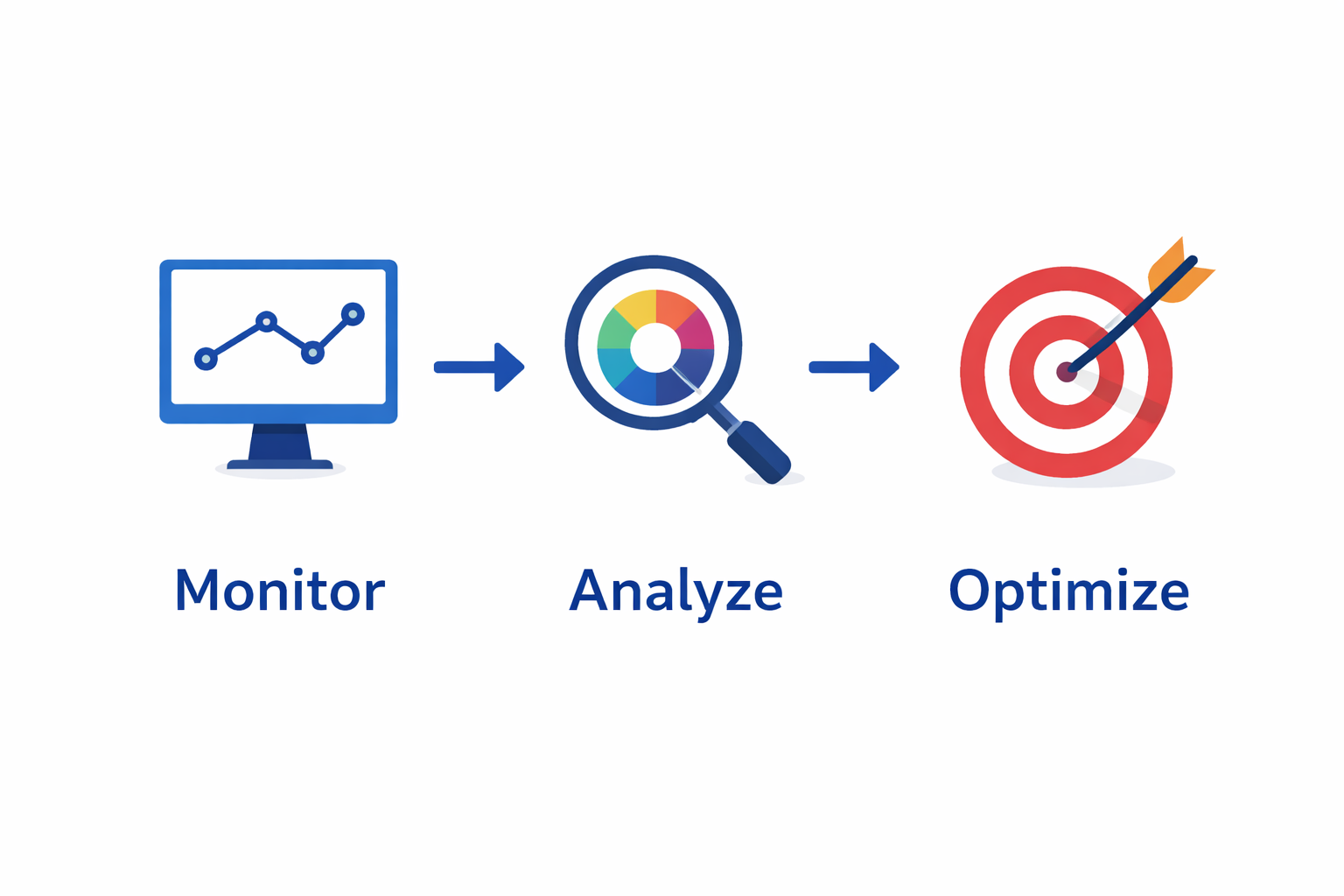
A one-time audit gives you a snapshot. Ongoing monitoring reveals trends. For most B2B companies, bi-weekly tracking works well. Run your full prompt map every two weeks and compare against previous periods. Track your AI SoV over time, each competitor's trajectory, and sentiment shifts across all brands.
Monthly, do a deeper analysis. Did a competitor publish a major research report and suddenly start appearing in more prompts? Did they get featured in an industry publication and see a sentiment improvement? These cause-and-effect patterns reveal what actually moves the needle.
The Competitive Tracking Template
Use this framework to organize your tracking data:
| Metric | Your Brand | Competitor A | Competitor B | Competitor C |
|---|---|---|---|---|
| AI SoV (% of prompts mentioned) | — | — | — | — |
| Avg. mention position | — | — | — | — |
| Positive sentiment ratio | — | — | — | — |
| Awareness prompt coverage | — | — | — | — |
| Consideration prompt coverage | — | — | — | — |
| Decision prompt coverage | — | — | — | — |
| Top citation source | — | — | — | — |
| ChatGPT presence rate | — | — | — | — |
| Perplexity presence rate | — | — | — | — |
| Gemini presence rate | — | — | — | — |
Fill this table after each tracking session and maintain a historical log. After 2-3 months, you'll have enough data to identify meaningful trends rather than noise.
Turning Competitive Data Into Action
Tracking without action is just expensive curiosity. Here's how to convert competitive intelligence into content and visibility improvements.
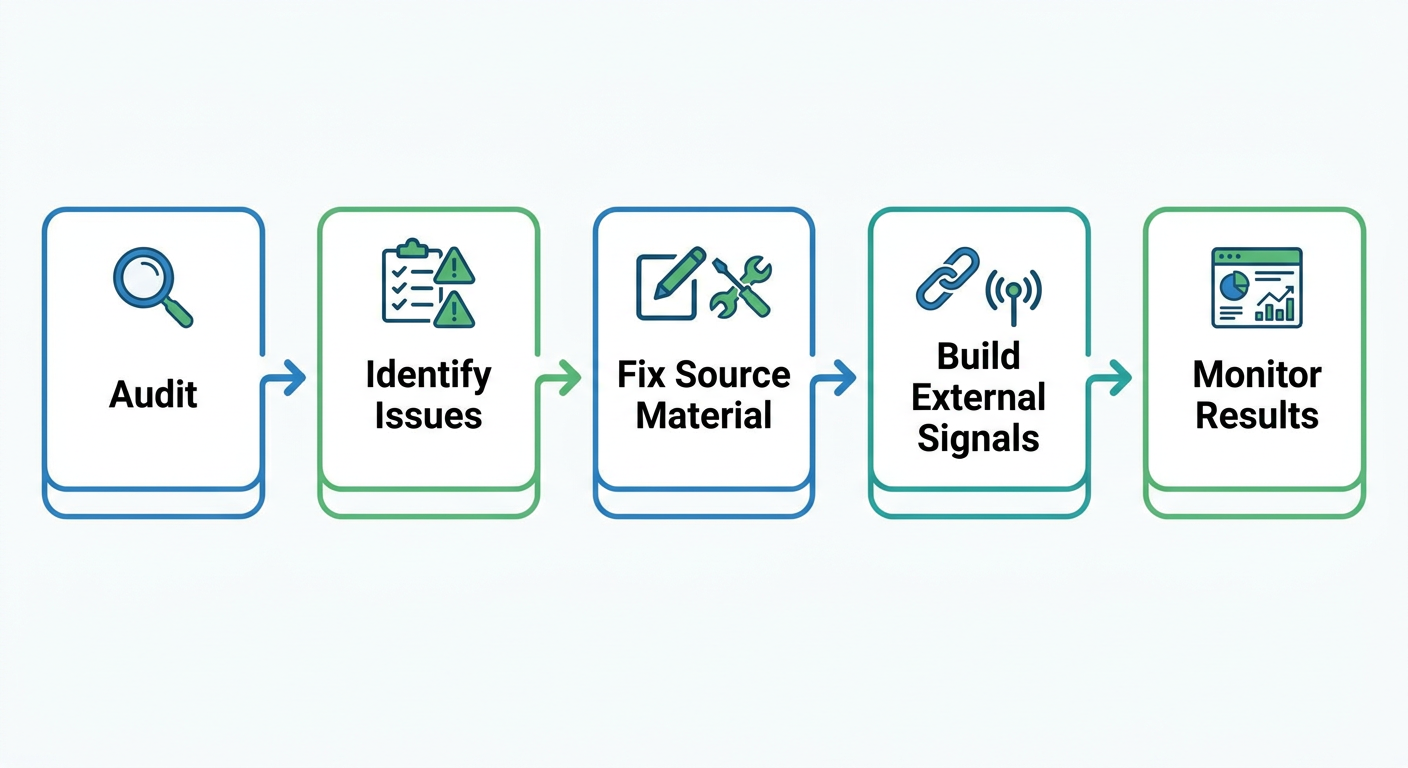
When you find a presence gap, examine the cited sources for the competitor who's winning that prompt. If they're cited from a comparison article on a third-party site, pitch that publication or create your own comparison content. If their product page gets cited because it clearly answers the question in the first 100 words, restructure your own page with a direct answer lead. The RepuAI blog has a detailed breakdown of what types of content get cited by AI search engines that can guide your content restructuring.
When you find a sentiment gap, audit what's driving the negative framing. AI models often pull sentiment from reviews, Reddit threads, and comparison articles. If your brand gets described with qualifiers like "suitable for smaller teams" while your competitor gets "enterprise-ready," the fix isn't on your website alone. You need third-party content that reinforces your desired positioning. The RepuAI article on whether AI search engines can damage your brand reputation covers this dynamic in depth.
When you find a source gap, prioritize the domains AI trusts most. Building presence on platforms like G2, Capterra, and relevant industry publications compounds over time. Each credible external mention strengthens the signal AI models use when deciding which brands to recommend.
Scaling Beyond Manual Tracking
The manual process works for establishing a baseline and building intuition. But running 60-80 prompts bi-weekly across four platforms takes 3-4 hours per session. For teams tracking more than three competitors, that time adds up fast.
This is where dedicated AI visibility platforms become practical. RepuAI automates exactly this process: monitoring how your brand and competitors appear across AI search engines, tracking sentiment shifts, and alerting you when competitive dynamics change. Instead of manual spreadsheets, you get a continuous data feed showing AI Share of Voice, competitor movements, and citation sources in one dashboard.
Before investing in any tool, run the manual process at least twice. You'll understand the data well enough to evaluate whether a platform's output matches reality. If you want a quick starting point, RepuAI's free Site Checker gives you an AI Visibility score alongside SEO and AEO metrics in under 30 seconds.

What to Do This Week
Don't wait for the perfect setup. Start with these three actions today.
First, run your single most important commercial query on ChatGPT, Perplexity, and Gemini. Document who appears. That takes five minutes and gives you an immediate read on your position.
Second, identify your top three AI competitors from those results.
Third, build your prompt map with 15-20 queries across awareness, consideration, and decision stages. Schedule your first full audit for this week.
The brands that start tracking AI competitive dynamics now will have months of trend data by the time their competitors realize the game has changed. In a channel where only 1-3 brands get recommended per query, early intelligence creates a compounding advantage that's hard to reverse.