How to Get Your Brand Cited by ChatGPT in 2026
ChatGPT cites brands from answer capsules, original data, and trusted third-party sources. Here's how to get your brand cited by ChatGPT in 2026
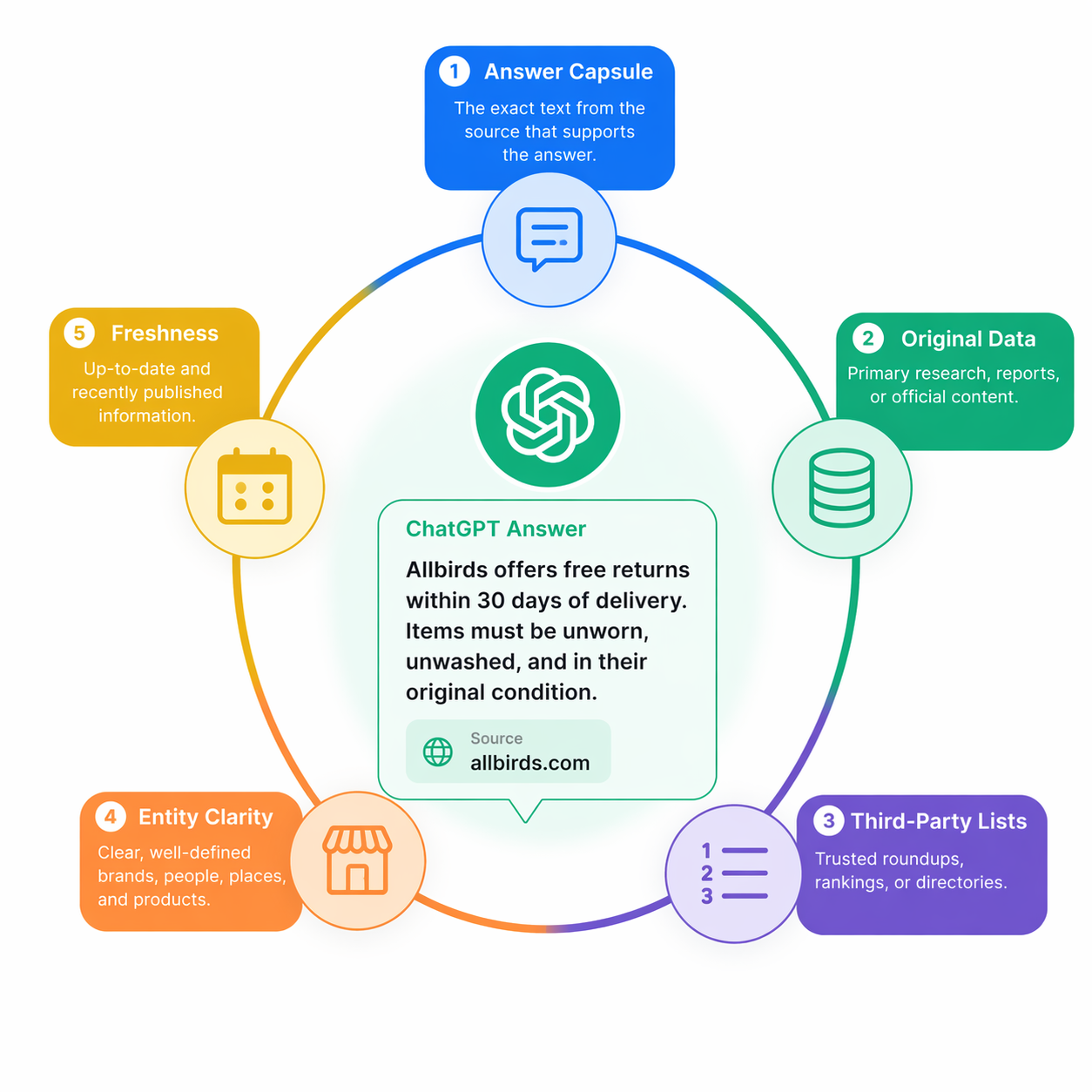
How to Get Your Brand Cited by ChatGPT in 2026
When someone asks ChatGPT for the best tool in your category, the model typically names two or three brands. If yours isn't one of them, you don't exist in that conversation. And unlike Google, there's no page two to fall back on.
ChatGPT now answers more than 2 billion queries per month, with a growing share of them being product research and vendor evaluation. The brands that appear in those answers didn't get there by accident. Across studies of millions of citations, the same structural patterns keep showing up, and most of them have surprisingly little to do with how good your product actually is. Here's what actually drives ChatGPT citations in 2026, and how to engineer for them.
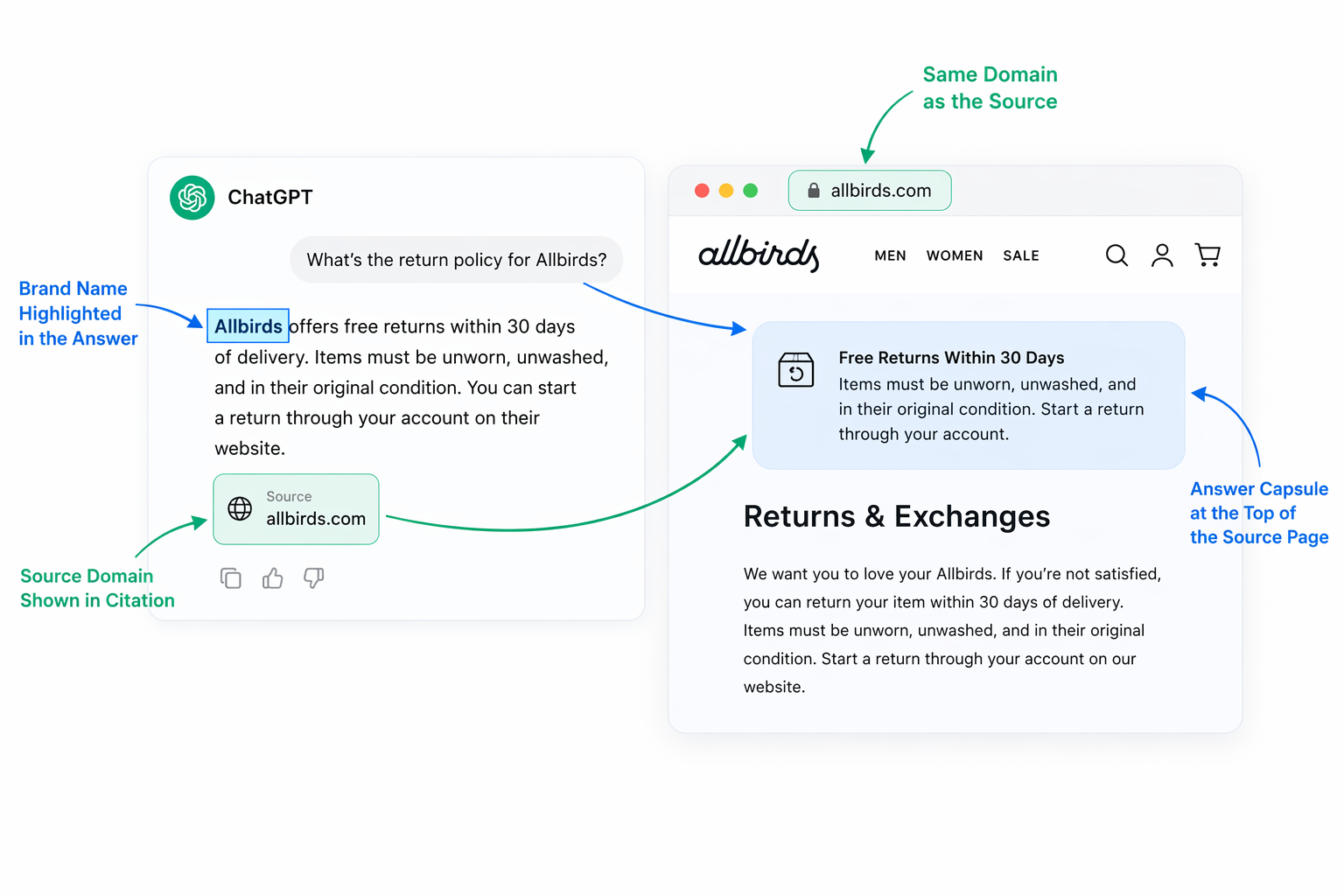
Why ChatGPT Picks One Brand and Ignores Another
ChatGPT doesn't read your site the way a human does. When a user asks a question, the model uses retrieval-augmented generation, or RAG. It breaks the question into smaller sub-queries, retrieves pages that match those sub-queries based on semantic similarity, evaluates authority signals, and stitches together an answer from what it found.
Two practical things follow from this. First, optimizing for keyword rank isn't enough, because the model isn't matching keywords the way Google does. It's matching meaning. Second, cited pages tend to share specific structural traits, because those traits make content easier for the model to extract and trust.
One SearchEngineLand audit of 15 domains and nearly 7,500 ChatGPT referral sessions found that 72.4% of cited pages had the same single feature: a short, self-contained answer block near the top of the page. That pattern alone tells you most of what you need to know. Understanding how AEO, GEO, and traditional SEO differ helps frame the rest of the work.
The Five Signals That Drive ChatGPT Citations
Five signals keep surfacing across independent citation studies. None of them are silver bullets on their own. Stack three or four of them and citation probability rises sharply.
1. Answer Capsules at the Top of the Page
An answer capsule is a 40 to 60 word paragraph placed at the top of a section that directly answers a specific question. No hedging, no preamble, no internal links inside the block. The paragraph should be able to stand alone if you copied it out of the page.
This works because of how RAG databases process text. Before retrieval, the model breaks your page into vector chunks. A clean, dense answer block becomes a near-perfect chunk. A four-paragraph rambling answer dilutes the signal and usually loses the citation to a competitor who wrote more concisely.
2. Original Data and Proprietary Insights
Across the same SearchEngineLand audit, 52% of cited posts contained either original data or branded owned insight. When an answer capsule and proprietary data appeared together, citation rates were highest. The model has a clear reason to cite you over a dozen lookalike pages: you have something no one else has.
You don't need a large research budget. A survey of 100 customers, an internal benchmark from anonymized platform data, or a "State of [Category] 2026" piece with real numbers is often enough to become a repeat source.
3. Third-Party "Best of" List Placements
Most ChatGPT citations don't come from your own domain. They come from comparison articles, review aggregators, and curated directories that rank for the relevant commercial queries. If your category has a "Top 10 X Tools" post ranking on page one of Google, brands sitting in positions one through five in that list are cited by ChatGPT in a disproportionately high share of relevant answers.
This is why digital PR, guest posts, and outreach to list authors quietly moved from "nice to have" to one of the highest-leverage activities in AI visibility work.
4. Entity Clarity
ChatGPT doesn't think in URLs. It thinks in entities. When someone asks about project management tools, the model retrieves information about Asana, Monday.com, ClickUp, and cites pages connected to those entities. If your brand isn't a recognized entity in the model's knowledge graph, you're invisible regardless of content quality.
Entity clarity comes from three things: comprehensive Organization schema on your homepage (with sameAs links to Wikipedia, Wikidata, Crunchbase, and LinkedIn), a clear About page with consistent brand naming across the web, and third-party mentions that reinforce what you do and who you serve. Our guide to schema markup for AI visibility covers the exact markup worth implementing.
5. Freshness
AI systems have a strong recency bias. Data from multiple tracking platforms shows that citation rates drop sharply once a page passes roughly 90 days without an update. A guide published two years ago with no refreshes will lose ground to a newer page on the same topic, even if the older page is objectively more comprehensive.
You don't need to rewrite pages from scratch. Adding a new stat, updating a screenshot, refreshing an example, and moving the "Last updated" date forward is usually enough to reset the clock.
Technical Foundations You Can't Skip
Before any content work, confirm ChatGPT can actually read your pages. This is where most brands fail before they start.
Check Your robots.txt
ChatGPT retrieves content through two main user agents: GPTBot (for training data) and ChatGPT-User (for live browsing). Perplexity uses PerplexityBot, Claude uses ClaudeBot, and Google uses Google-Extended for AI-specific crawling. If any of these are disallowed, the corresponding platform can't cite you.
Cloudflare changed its default configuration in 2024 to block AI bots automatically. If you're on Cloudflare and haven't explicitly opted AI crawlers back in, there's a real chance your site is invisible to ChatGPT right now. Check your Cloudflare AI Crawl Metrics dashboard and your server logs for GPTBot activity before anything else.
Server-Render Your Important Content
AI crawlers don't execute JavaScript the way a browser does. They read the raw HTML the server returns. If your pricing, key features, or core content sits behind a tab, a dropdown, or a client-side render, the crawler won't see it.
One practitioner reported that a client's most-cited pricing page lost its citations entirely after a JavaScript migration that moved pricing into a collapsible component. The fix was moving pricing back into static HTML. Citations recovered within about six weeks.
The Off-Site Layer
A pattern shows up across every large citation study: most ChatGPT mentions don't come from brand-owned content. They come from places the brand doesn't fully control.
Reddit is the single most-cited domain across AI search, with data from Superlines showing Reddit appearing in roughly 34.7% of tracked ChatGPT responses. YouTube's share of social media citations has been growing fast, rising from about 19% to 39% in a five-month stretch through early 2026. Review platforms (G2, Capterra, Trustpilot) carry heavy weight for vendor evaluation queries, and aggregate scores below 4.0 noticeably reduce citation probability in competitive categories.
The practical read is that brands appearing across three or more trusted off-site channels see dramatically higher citation rates than brands relying solely on their own website. Treat Reddit, YouTube, and review sites as citation surface area, not afterthoughts.
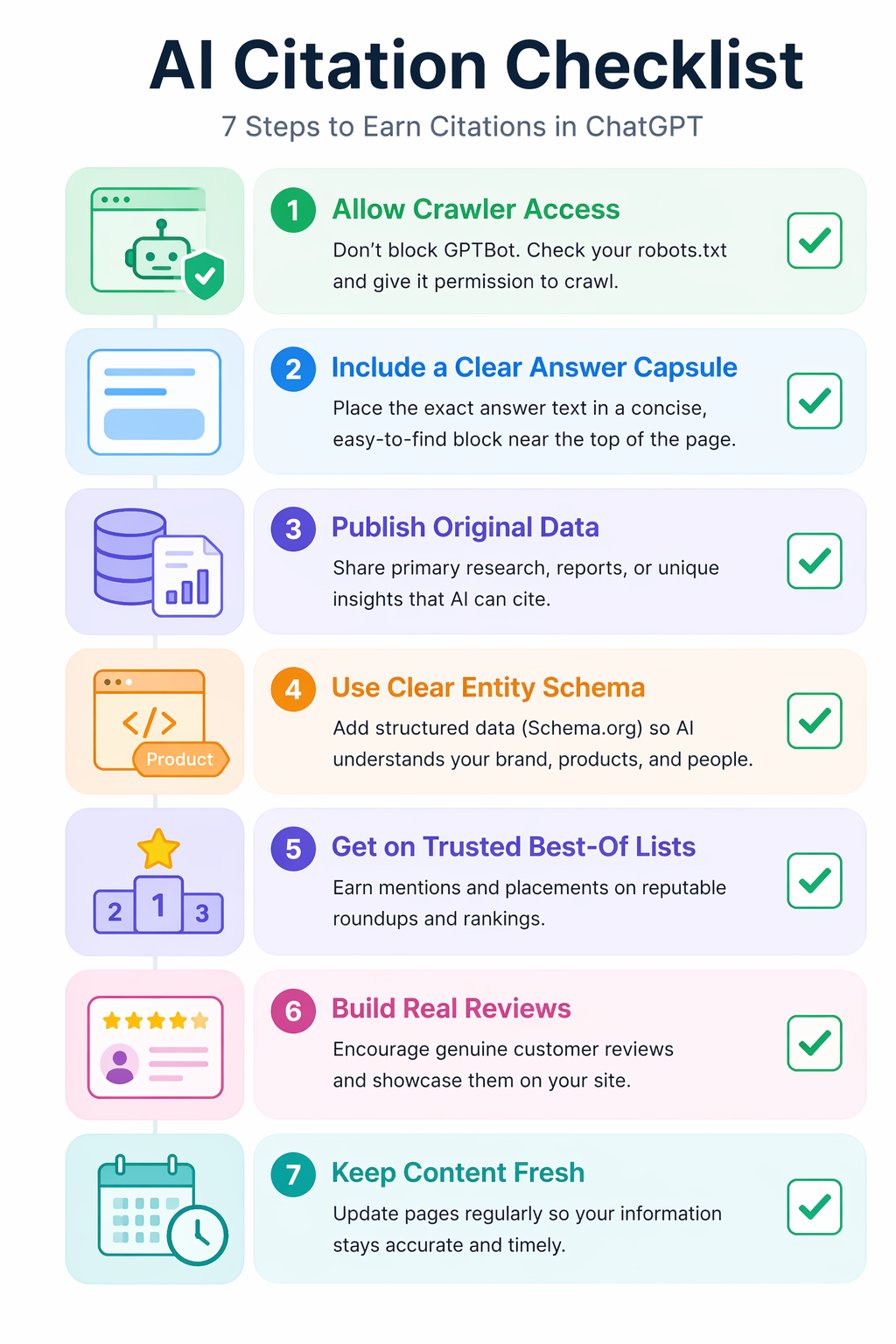
A 7-Step Checklist to Start Getting Cited
Work through these in order. The first three are the highest leverage for most teams.
- Audit crawler access. Confirm your robots.txt allows GPTBot, ChatGPT-User, ClaudeBot, PerplexityBot, and Google-Extended. If you're on Cloudflare, check AI bot settings explicitly.
- Add an answer capsule to your top 10 pages. A 40 to 60 word paragraph near the top, directly answering the query the page targets, with no links inside the block.
- Publish one original-data piece per quarter. A small customer survey, a benchmark from your product data, or a proprietary metric nobody else has.
- Tighten your entity footprint. Comprehensive Organization schema with sameAs links, consistent brand naming everywhere, and ideally a Wikipedia or Wikidata entry.
- Earn two or three "best of" list placements this quarter. Target the posts that already rank on page one of Google for your category.
- Build a review presence with a 4.0+ average on the platform your category actually uses. Prompt customers to describe specific use cases, not just star ratings.
- Refresh your top cited pages every 90 days. Update a stat, add a new example, and change the visible "Last updated" date. You're also free to generate a starting llms.txt file to summarize your core content for AI crawlers.
How to Track What's Actually Working
None of this matters if you can't tell whether it's working. Google Analytics reports most ChatGPT referrals as direct or obscured traffic, and Search Console doesn't cover AI engines at all. You need to see two things separately: whether your brand is appearing in AI answers for the prompts your buyers actually use, and which pages and sources those answers are pulling from.
That's the gap RepuAI was built to close. It monitors how your brand shows up across ChatGPT, Perplexity, Gemini, and Claude for the prompts you care about, tracks sentiment and citation sources over time, and flags when a competitor takes your spot in a key answer. Before making any changes, you can also run a free AI visibility check to see how your site looks to LLM crawlers today and which signals are missing. Pair that with a clean AI visibility KPI framework and you'll know within 60 days whether the work is compounding.
The Compounding Payoff
ChatGPT citations stack. Once the model recognizes your brand as authoritative in a category, the same entity tends to surface across dozens of adjacent prompts. Getting there usually takes 90 to 180 days of consistent work across content, technical access, and earned presence.
Start with the capsule. Fix the crawler issue. Earn one list placement. Then do it again next month. The brands cited today are the ones that treated AI visibility as a real discipline six months ago, not a one-time audit.


