Google RankBrain: How Google's AI Changed the Rules of Search and Why It Matters for Your Brand
What is Google RankBrain and how does it affect your brand's visibility? We break down how Google's machine learning algorithm works, its connection to AI search, and the specific steps you can take to optimize — from traditional SEO to visibility in ChatGPT and Perplexity
Imagine typing something like "gray console made by Sony" into Google. You never wrote the word "PlayStation." But Google knows that's exactly what you're looking for. Ten years ago, the search engine would have been stumped. Today, it figures out queries like this in milliseconds. The technology behind this magic has a name - Google RankBrain.
And if you think RankBrain is a relic from the SEO history archives, here's some news: this algorithm is not only alive and well, it has become the foundation for everything Google does with artificial intelligence in search today.
Let's break down how it works, why it matters more than ever, and what all of this means for your brand's visibility - in traditional search and in the new AI-powered engines.
What Is Google RankBrain — and Why Is Everyone Talking About It Again
Google officially confirmed RankBrain's existence on October 26, 2015. It's a machine learning system built into Google's core algorithm (Hummingbird) that helps process search results and understand what users are actually looking for.
At launch, RankBrain handled roughly 15% of all search queries — specifically, the ones Google had never seen before. That might not sound like much. But when Google processes billions of queries a day, 15% translates to hundreds of millions of searches the engine previously couldn't handle properly.
Today, RankBrain is involved in virtually every query. Google called it the third most important ranking factor — after content and links. And Google's own experiments showed that RankBrain picks the best result more accurately than human search engineers: 80% accuracy for RankBrain versus 70% for humans.
How RankBrain Works: Two Key Mechanisms
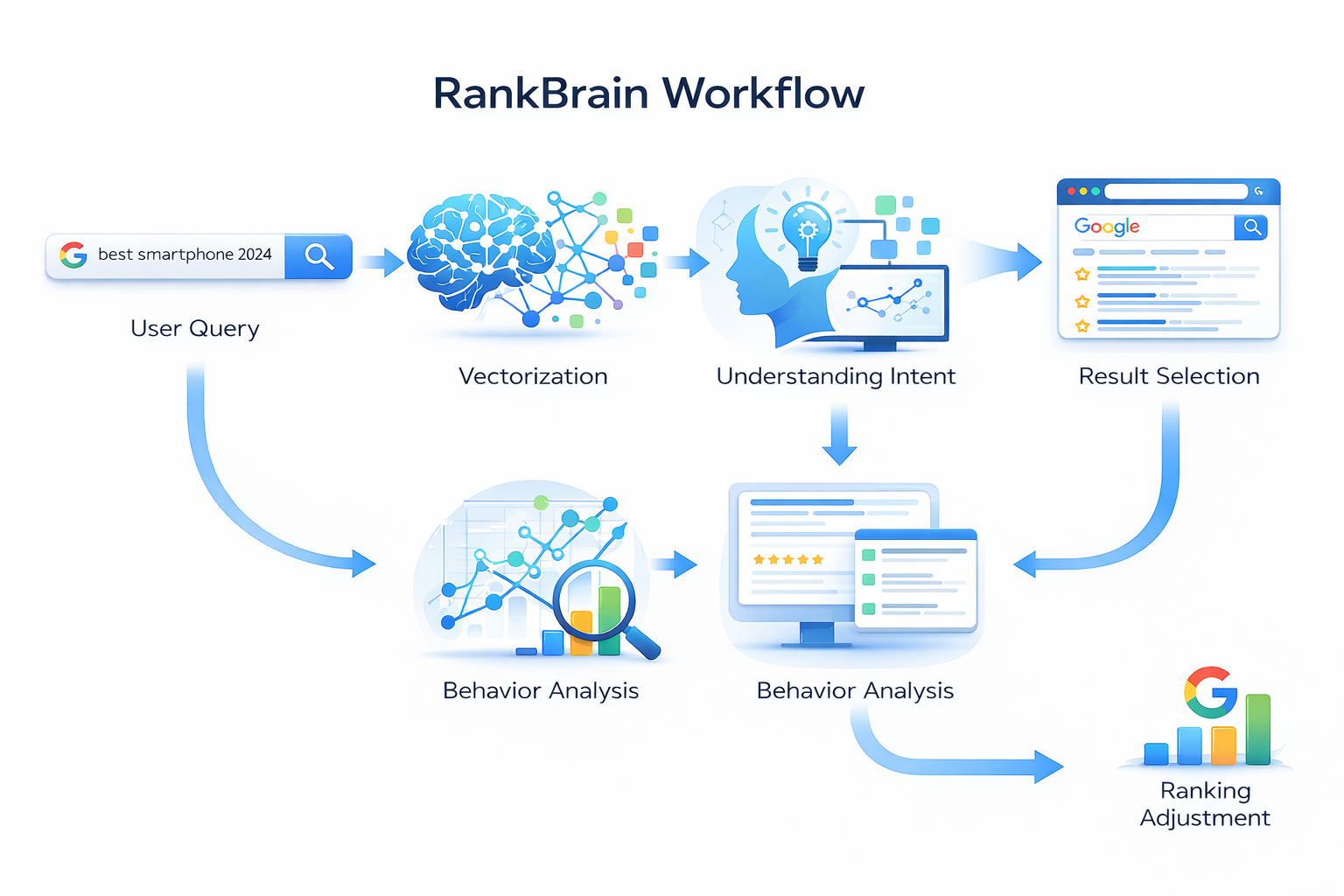
RankBrain isn't a standalone algorithm that replaces everything else. It's a component inside Hummingbird, like a part within a car engine. And it has two main functions.
1. Understanding Query Meaning
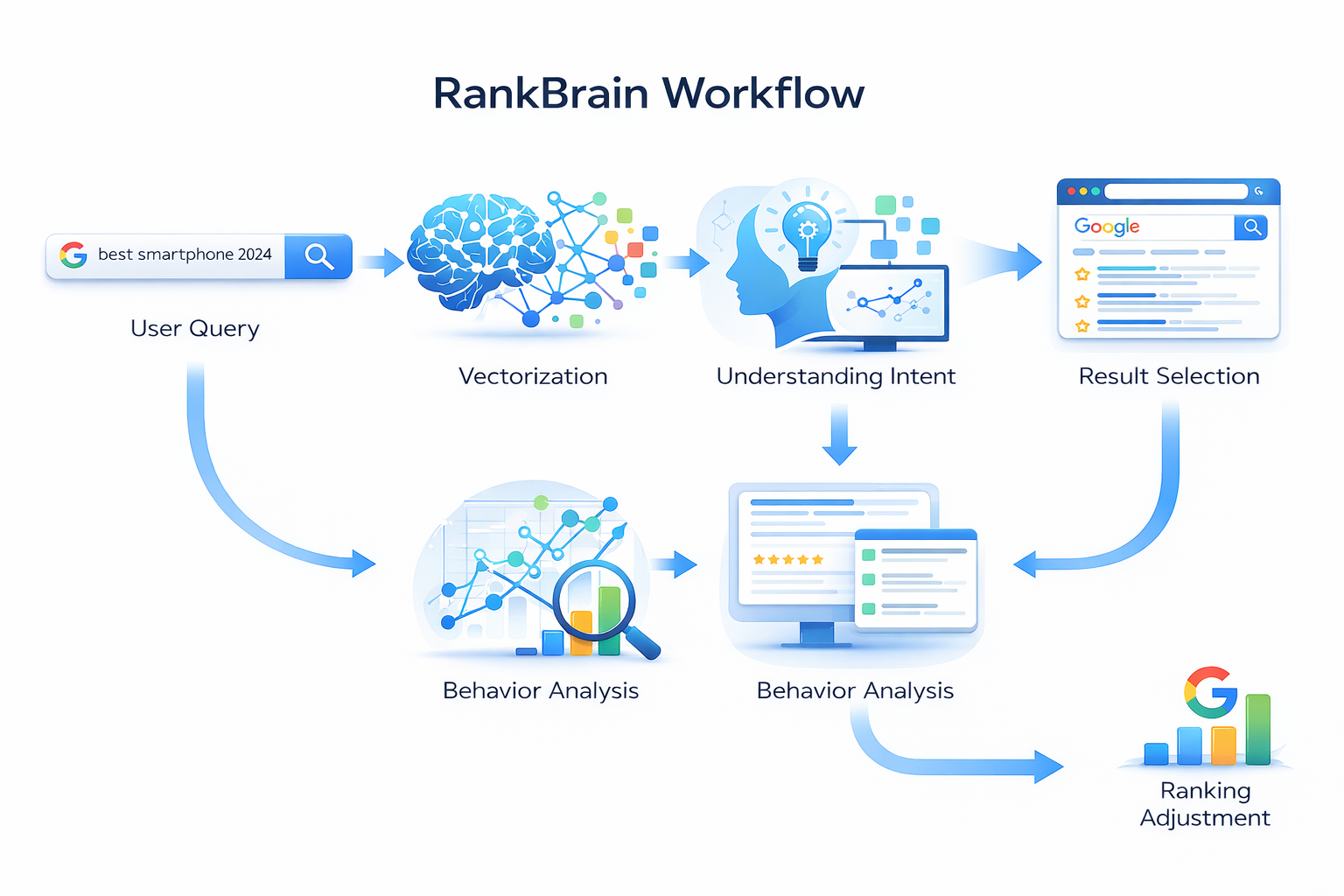
Before RankBrain, Google looked at individual words in a query and tried to find pages with exact matches. RankBrain changed the approach: it converts words into mathematical vectors (numerical representations) and searches for connections between concepts.
A simple example: if someone searches "what to wear in the rain to a business meeting," RankBrain understands the query isn't just about "rain" or "clothes" — it's about a specific situation. It connects the concepts of "business attire," "rain protection," and "recommendations" — and serves relevant results, even if no single page contains that exact phrase.
This became possible through the shift from "strings" to "entities." Google stopped seeing text as a collection of characters and started recognizing real-world objects: people, companies, products, places.
2. Learning from User Behavior
Here's what makes RankBrain truly smart: it watches how people interact with search results. Did the user click a result and stay on the page? Good sign. Did they bounce back after 5 seconds and click another result? That means the first page didn't answer their question.
RankBrain uses these signals to continuously fine-tune rankings. It can dynamically adjust the weight of different factors — backlinks, content freshness, text length, domain authority — depending on the specific query. If users show that a new order of results works better, it stays. If not, the system rolls back the changes.
In essence, RankBrain is a perpetual A/B test at the scale of billions of queries.
RankBrain in 2025–2026: Not a Museum Piece, but the Foundation
Some SEO professionals consider RankBrain outdated — after all, BERT, MUM, and Gemini came along, and RankBrain was supposedly left behind. This is a misconception.
RankBrain hasn't gone anywhere. It evolved into what experts call the "reasoning layer" — the connective tissue between all of Google's AI systems. BERT handles deep natural language understanding. MUM processes multilingual and multimodal queries. Gemini powers generative answers. And RankBrain orchestrates all of it, deciding how much weight to give each signal for a specific query.
Think of it as a conductor of an orchestra: each instrument (BERT, MUM, Gemini) plays its part, but RankBrain decides when and how loud.
What This Means for Brand Visibility — and Why SEO Alone Is No Longer Enough
Now for the really interesting part. Understanding RankBrain isn't just an academic exercise. It's a direct path to understanding how AI search works as a whole.
RankBrain was the first time machine learning was embedded into Google's core search algorithm. Everything that followed — BERT, AI Overviews, AI Mode — grew from the same logic: understand intent, not keywords.
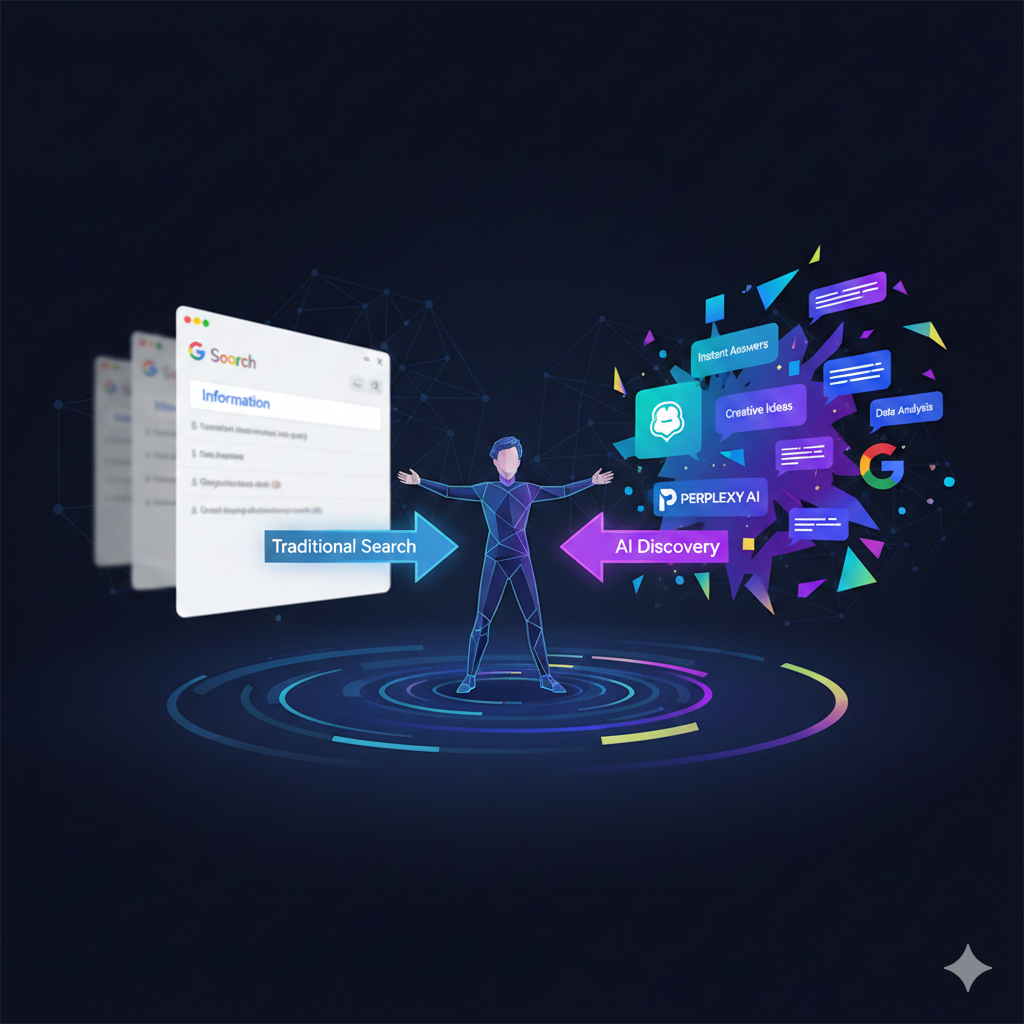
And here's the problem for brands: that same logic now operates in ChatGPT, Perplexity, Claude, and other AI platforms. Except the rules there are even stricter.
In traditional Google, you get a list of 10 links — even if you're in 7th place, you're at least visible. In AI search, there's one answer. If the AI engine doesn't consider your brand authoritative, relevant, and trustworthy enough — you simply don't exist to the user.
According to expert estimates, traditional search will lose up to 50% of its share by 2028. AI answers already appear in 57% of Google results. ChatGPT serves 400 million users weekly.
7 Actionable Steps to Optimize for RankBrain and AI Search
The good news: the principles that work for RankBrain also work for the new AI engines. Here's what you should be doing right now.
1. Optimize for Intent, Not Keywords
RankBrain analyzes user intent. Stop thinking in terms of "which keywords to insert" and start thinking: "what problem is this person trying to solve?" Group queries into intent clusters: informational, transactional, navigational.
2. Create Content That Answers Real Questions
AI systems (RankBrain included) prioritize content that explores topics in depth. Not 300-word posts written for SEO, but comprehensive guides that fully address the user's question.
3. Work with Structured Data
Schema markup helps both Google and AI engines understand what your content is about. FAQ schema, organization markup, product and author markup — all of this increases your chances of being cited in AI responses.
4. Pay Attention to User Experience
RankBrain factors in behavioral signals. Page load speed, mobile usability, Core Web Vitals — all of these affect how users interact with your site, and therefore your rankings.
5. Build Brand Authority Beyond Your Website
AI systems aggregate signals from multiple sources: press mentions, reviews, social media, forums. Brands with a strong presence across multiple channels receive more mentions in AI responses. Estimates suggest roughly 250 quality publications are needed to meaningfully influence how an LLM perceives a brand.
6. Update Your Content Regularly
Fresh content gets priority in both RankBrain and AI engines. If your last blog post is two years old, AI systems will more likely cite a competitor's more up-to-date source.
7. Monitor Your AI Search Visibility
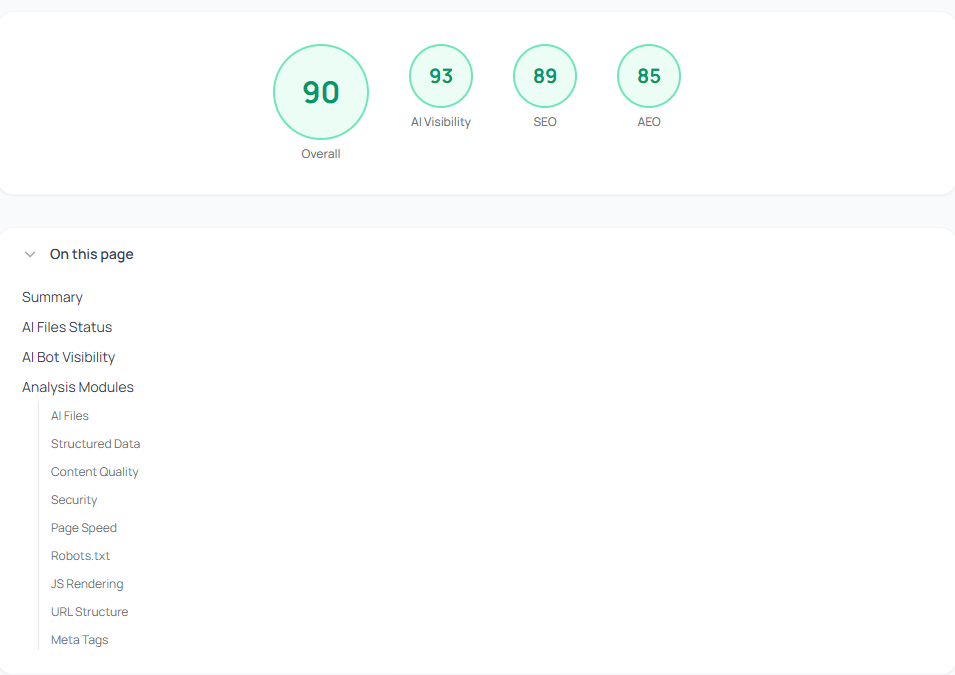
You can't improve what you don't measure. Traditional SEO tools don't show how your brand appears in ChatGPT, Perplexity, or Gemini responses. You need specialized solutions for that — and this is exactly the problem RepuAI solves, tracking mentions, sentiment, and visibility of your brand across AI search engines.
From RankBrain to GEO: The New Reality of Search Optimization
RankBrain ushered in an era where machine learning became an integral part of search. But that era isn't standing still. Today, a new discipline is gaining momentum — Generative Engine Optimization (GEO), optimization for generative search engines.
The logic of GEO is simple: if you used to optimize for an algorithm that ranks links, now you need to optimize for an algorithm that generates answers. And that's an entirely different game.
In the world of GEO, your brand needs to be:
- Recognizable — the AI system must know you exist from multiple sources
- Authoritative — expert quotes, press mentions, and reviews shape your "digital reputation"
- Structured — AI works more easily with clearly organized, marked-up content
- Current — outdated information = an outdated brand in the eyes of AI
And here the circle closes: the principles RankBrain established — understanding intent, focusing on the user, continuous learning — have become the foundation for all modern AI search systems.
Instead of a Conclusion: What to Do Right Now
RankBrain was the first — but far from the last — step Google took toward AI-driven search. Understanding its principles gives you a strategic advantage: you see not individual algorithm updates, but the overall direction the industry is heading.
That direction points one way: from keywords to meaning, from links to authority, from SERP positions to mentions in AI responses.
Brands that understand this now will find themselves in a winning position. The rest will be playing catch-up.
Want to find out how your brand looks through the eyes of AI right now? Start with a free audit at RepuAI — and see for yourself whether artificial intelligence can see you.